

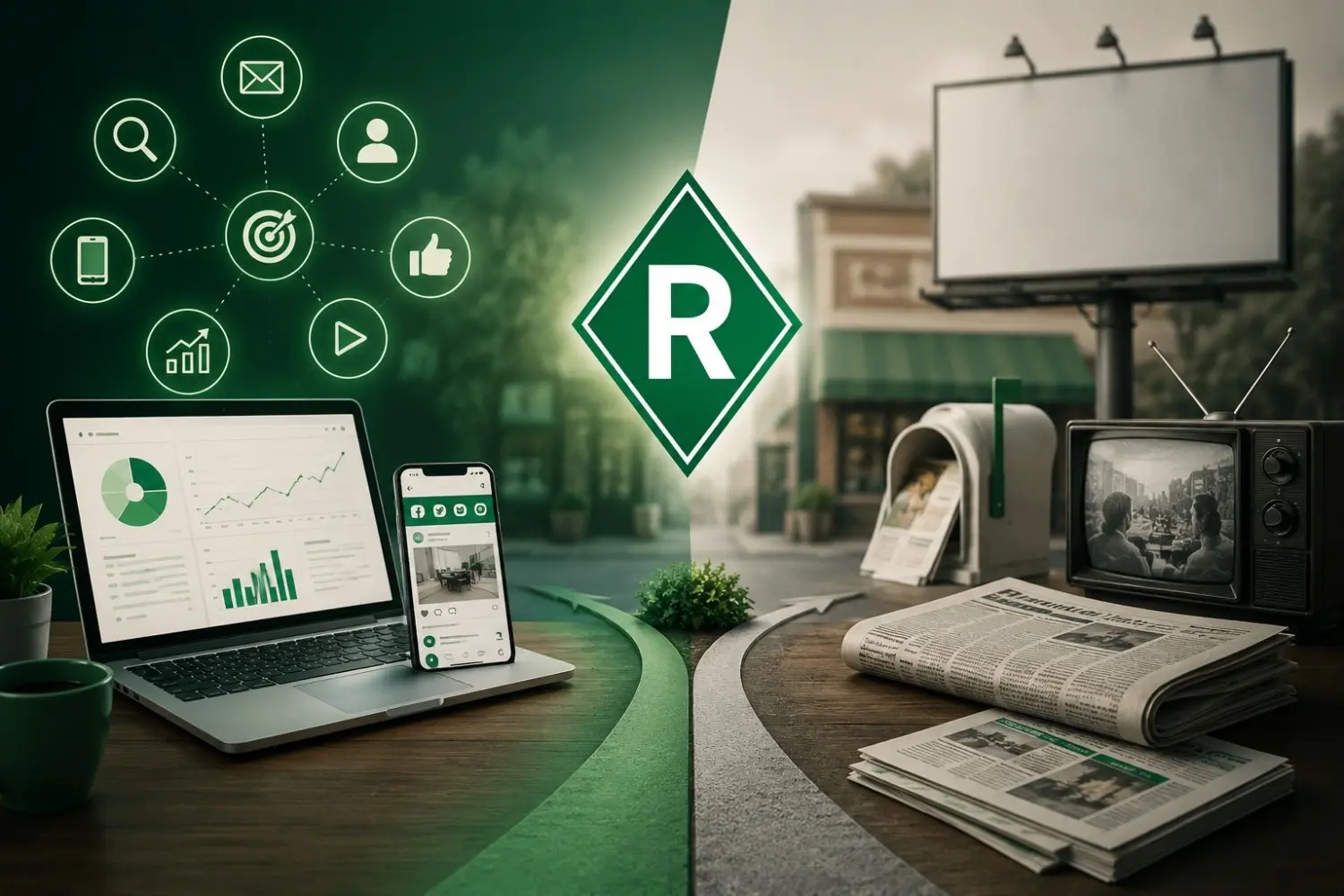
Digital marketing vs traditional marketing digital wins for most small businesses in 2026 due to lower cost, precise targeting, measurable ROI, and 24/7 reach. However, traditional marketing still outperforms digital in specific scenarios: local community events, older demographic targeting, high-trust in-person environments, and tactile brand experiences like direct mail. The best strategy for most Ohio small businesses is an integrated approach using digital as the foundation and traditional as a targeted complement.
Digital marketing vs traditional marketing is a debate that has been happening in boardrooms and business strategy sessions since Google ran its first ad in 2000. And in 2026, with AI-driven search, social media algorithms, and hyper-local targeting available to even the smallest Ohio business, you might expect the answer to be obvious. But here is the truth most marketing agencies will not tell you: traditional marketing is not dead it is just being used wrong by the wrong businesses in the wrong situations.
The real question is not which one is better. It is which one is better for your specific business, your specific customer, and your specific market right now. And the answer is more nuanced than any blanket statement can capture.
Let us break it down the way it actually matters to a small business owner in central Ohio trying to grow.
What Is Traditional Marketing vs Digital Marketing? (Direct Definition)
Traditional marketing covers any promotional activity that operates through offline channels, print advertising (newspapers, flyers, brochures), direct mail, radio and television spots, billboards, signage, cold calling, and in-person events. These channels have been the backbone of local business advertising for generations.
Digital marketing covers every promotional activity that operates through internet-connected channels search engine optimization (SEO), Google Ads, social media marketing, email campaigns, content marketing, website design, and video advertising on platforms like YouTube and streaming services.
The core distinction comes down to targeting, measurement, and reach. Traditional marketing casts a wide net with limited ability to track who actually saw your message. Digital marketing casts a precise net with the ability to track every click, call, and conversion back to a specific ad, keyword, or piece of content.
The Real Benefits of Traditional Marketing (Where It Still Wins)
Traditional marketing benefits are genuine but they are specific. Here is where traditional still outperforms digital for certain audiences and goals.
Local Community Presence and Brand Familiarity
There is a reason local businesses in small Ohio communities still advertise in the county fair program, sponsor Little League teams, and run ads in the community newspaper. For businesses whose primary customer base is older, hyper-local, and less digitally engaged, these channels build the kind of familiarity that no Google Ad can replicate.
A handshake at a Chamber of Commerce event, a billboard on Route 33, or a branded pen left at the bank counter reaches people who may never Google your service but will absolutely remember seeing your name three times around their community this month. Frequency and familiarity in a small geographic area is still a real traditional marketing strategy that works.
Direct Mail Response Rates for Specific Demographics
According to the Data & Marketing Association, direct mail achieves a response rate of 4.4% compared to email’s 0.12%. For certain demographics particularly homeowners over 55 in rural Ohio communities a well-designed mailer to a targeted ZIP code outperforms a Facebook ad to the same audience. When the channel matches the customer, traditional marketing benefits are measurable and significant.
High-Trust Environments and Tangible Experiences
A physical brochure in someone’s hands carries a different kind of authority than a Facebook post in a feed. For high-consideration purchases financial services, healthcare decisions, real estate a leave-behind piece of printed collateral after an in-person meeting reinforces trust in a way that a retargeting ad cannot fully replicate.
The Real Benefits of Digital Marketing (Why It Wins for Most Businesses)
Digital marketing effectiveness comes from four core advantages that traditional channels simply cannot match at any comparable budget level.
Precise Targeting Reach Exactly Who You Want
Google Ads can target someone searching for “emergency HVAC repair near Marysville Ohio” at 9pm on a Tuesday. A radio ad cannot. The ability to reach a customer at the moment of their highest purchase intent with a message specifically written for their exact search is the defining competitive advantage of digital marketing for small businesses.
Local SEO and Google Maps optimization go even further: your business appears when someone within miles of your location searches for what you offer without paying for every impression.
Measurable ROI Know Exactly What Is Working
Traditional marketing strategies leave significant attribution gaps. If you run a newspaper ad this month, how do you know which customers called because of it? With digital marketing, every click, call, form submission, and purchase traces back to a specific keyword, ad, or piece of content. This measurability allows for continuous improvement that compounds over time.
Cost-Effective Entry Point for Small Businesses
A 30-second local television spot can cost $1,500 to $10,000+ to produce and place. A well-managed Google Ads campaign can begin generating qualified leads for an Ohio small business with a $500–$1,000 monthly budget. For most Richwood Bank business customers operating with small business budgets, digital marketing strategies simply offer better ROI at accessible investment levels.
24/7 Reach That Compounds Over Time
A billboard is seen only when someone drives past it. An SEO-optimized website page, a published blog article, or a live Google Business Profile works for your Ohio business around the clock generating leads on Saturday evening, on holidays, and long after the content was originally created. Digital marketing effectiveness comes precisely from this compounding, always-on nature.
Head-to-Head Comparison: Traditional vs Digital Marketing
|
Factor |
Traditional Marketing |
Digital Marketing |
|
Cost to Start |
High ($500–$10,000+) |
Low ($300–$2,000/month) |
|
Targeting Precision |
Broad geographic/demographic |
Hyper-specific: keyword, location, behavior |
|
Measurability |
Limited, estimated |
Exact: clicks, calls, conversions tracked |
|
Reach Speed |
Immediate (print, radio) |
Immediate (Ads) or 3–6 months (SEO) |
|
Audience Age Fit |
Strong 55+ demographics |
Strong 18–54 demographics |
|
Trust Building |
High (physical, in-person) |
Builds with content, reviews, consistency |
|
ROI Tracking |
Difficult |
Precise and continuous |
|
Shelf Life |
Short (ads run while paid) |
Long (SEO content compounds for months/years) |
|
Best For |
Community awareness, older demos, high-touch |
Lead generation, broad reach, measurable growth |
When to Choose Traditional, When to Choose Digital (Decision Guide)
Choose traditional marketing when:
- Your primary customer is 60+ and less digitally active
- You are building local community familiarity in a small Ohio town
- You are hosting or sponsoring a physical community event
- Your sales process is highly relationship-driven and in-person
- You want to reinforce a digital campaign with physical touchpoints
Choose digital marketing when:
- You need measurable lead generation with a trackable ROI
- Your customers search Google before making any purchase decision
- You are competing against businesses with larger traditional ad budgets
- You want to scale reach without proportionally scaling spend
- You serve customers across multiple Ohio cities or service areas
The integrated answer for most Ohio small businesses: Use digital marketing as your primary growth engine SEO, Google Ads, content, and a fully optimized Google Business Profile and add targeted traditional elements (event sponsorship, direct mail to specific ZIP codes, community newspaper) where they specifically reach your underserved audience.
The 2026 Reality: Why Digital Has Won the Foundation Battle
In 2026, consumer behavior has made one thing unmistakably clear: the research phase of almost every purchase decision now happens online. Even customers who discovered your business through a word-of-mouth referral, a yard sign, or a community event will Google your business before they call. They will read your reviews. They will check your website. They will look at your Google Business Profile.
This means that even for businesses whose primary discovery channel is traditional, the conversion moment is digital. A weak online presence turns traditional marketing awareness into lost opportunities. A strong digital foundation turns every traditional channel referrals, community visibility, signage into a warmer, more credible lead.
This is the most important strategic insight for Ohio small businesses in 2026: traditional and digital are not competitors, traditional creates awareness and digital converts it.
Why Trust Richwood Marketing With Your Marketing Strategy
At Richwood Marketing, we have watched Ohio small businesses succeed and struggle with both traditional and digital channels across Richwood Bank’s nine-branch central Ohio footprint since 2014. Our team includes the marketing services division for Richwood Bank business customers which means we work inside the same communities our clients serve, with a genuine stake in their long-term success.
We do not have a financial incentive to push you toward digital if tradition serves your specific business better. Our goal is the strategy that actually grows your revenue whether that is a full digital campaign, a hybrid approach, or a focused traditional effort in the right context. Richwood Marketing builds marketing strategies around your real market and your real customers, not a template applied equally to every business.
Frequently Asked Questions
Is digital marketing more effective than traditional marketing for small businesses in 2026?
For most small businesses, digital marketing delivers better ROI, precise targeting, and measurable results making it the more effective foundation for growth in 2026.
What are the biggest advantages of traditional marketing that digital marketing cannot replace?
Traditional marketing builds local community familiarity, reaches less-digitally active demographics, and creates physical trust signals that digital channels cannot fully replicate.
Can a small business in Ohio use both traditional and digital marketing together effectively?
Yes the most effective strategy for most Ohio small businesses combines digital as the primary growth engine with targeted traditional elements where specific audiences or community goals require it.
How do I know if my Ohio business should invest more in digital marketing vs traditional marketing?
If your customers search Google before buying, if you need measurable ROI, or if you compete across multiple cities digital is your priority. If your primary customer is local, older, and community-engaged, traditional plays a stronger supporting role.
What traditional marketing strategies still work best for small businesses in central Ohio?
Community event sponsorships, direct mail to targeted ZIP codes, local newspaper advertising in specific markets, and in-person networking all continue to produce results for Ohio businesses serving older or highly local audiences.
Conclusion: The Smartest Ohio Businesses Use Both But Start With Digital
Digital marketing vs traditional marketing is ultimately a false binary for most Ohio small businesses. The question is not which one wins universally, it is which channel best serves each specific goal, audience, and budget you are working with.
In 2026, the foundation for almost every small business growth strategy is digital: a fast, optimized website; a fully managed Google Business Profile; consistent local SEO; and targeted Google Ads when leads are needed immediately. Traditional marketing plays its best role as a community-building complement not the entire strategy.
The businesses in central Ohio that are consistently growing online are the ones that stopped asking “digital or traditional?” and started asking “what does my specific customer need to see, where do they need to see it, and how do I measure whether it worked?” Book Your Free Marketing Strategy Consultation with Richwood Marketing We will review your current marketing mix, identify where your Ohio business is missing the highest-value opportunities, and give you an honest, channel-by-channel recommendation based on your actual customers and your actual goals.
