
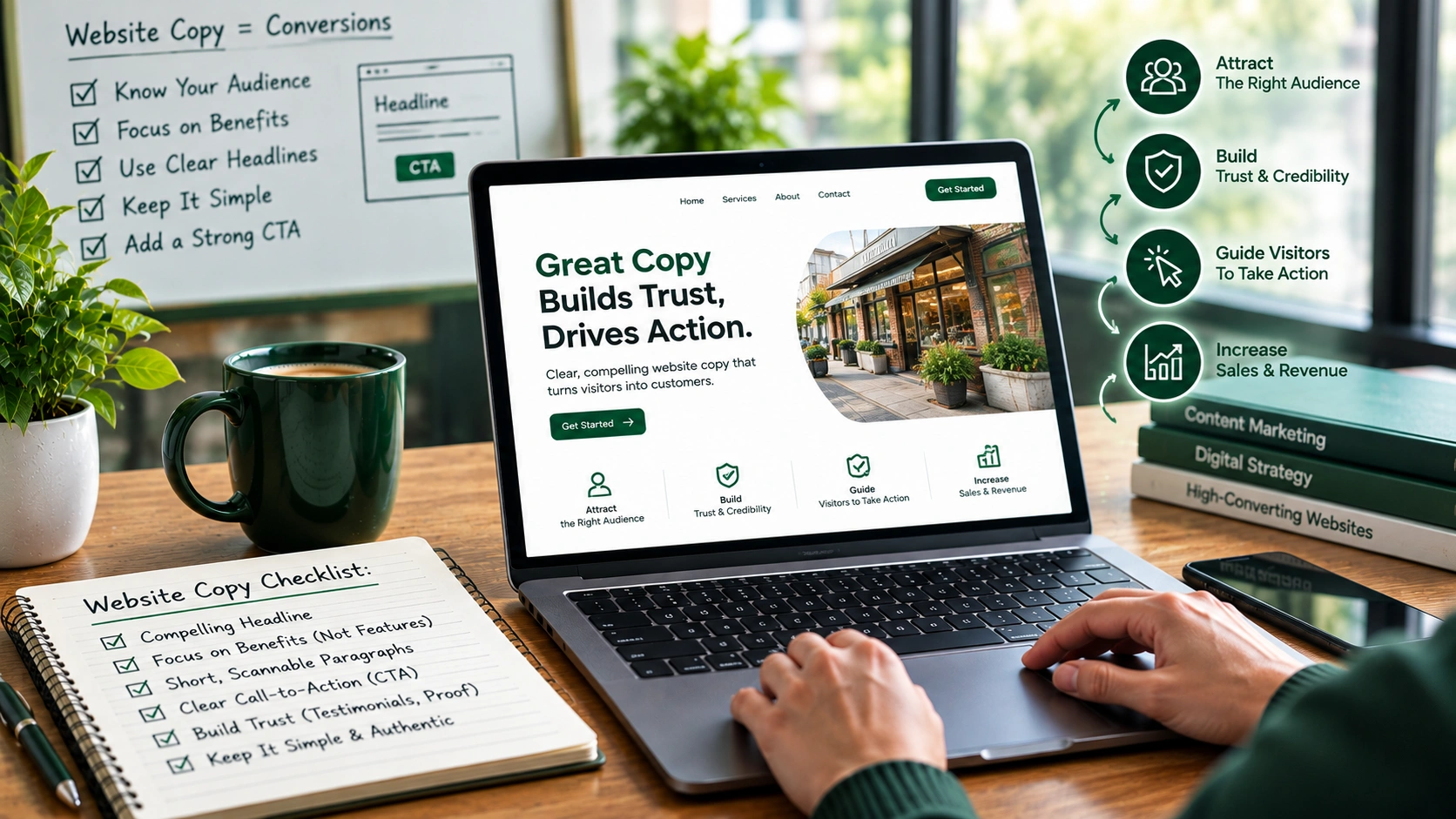
If your website gets traffic but not phone calls, form fills, or sales, the problem is rarely your design it’s your words. Learning how to write website copy that converts means writing every headline, sentence, and button with one job in mind: moving a stranger to the next step. In the sections below, you’ll get the exact framework, the mistakes that quietly kill conversions, and a page-by-page checklist you can apply to your own site today.
How to Write Website Copy That Converts
Conversion-focused website copy leads with your visitor’s problem (not your company history), uses one clear message per page, backs up claims with proof, and ends every section with a specific call to action. The highest-converting websites write for a 6th–8th grade reading level, put the main offer above the fold, and test their copy against real user behavior instead of guessing. Businesses that follow this structure typically see measurable lifts in form submissions and calls within 60–90 days of a copy rewrite.
What Is Conversion-Focused Website Copy?
Website copy is every word a visitor reads on your site headlines, service descriptions, About page, footer, and calls to action. “Conversion-focused” simply means that copy is written to produce an action (a call, a form submission, a purchase, a booked consultation) rather than just to inform. This is the core difference between website content for lead generation and copy that’s written just to fill space.
Most small business websites are written the wrong way around. They start with “Who we are” and “What we do,” when the visitor actually wants to know “Can you solve my problem, and can I trust you?” Persuasive website content flips that order: problem first, solution second, proof third, action last.
Why Most Website Copy Fails to Convert
Before fixing your copy, it helps to know why most business websites lose visitors in the first place:
- Vague headlines. “Quality Service You Can Trust” tells a visitor nothing about what you actually do.
- No clear call to action. Visitors won’t hunt for a phone number or contact form, they’ll leave instead.
- Too much company talk, not enough customer talk. Overusing “we” and “our” instead of “you” makes copy feel self-focused.
- Walls of text. According to eye-tracking research from the Nielsen Norman Group, users only have time to read about 20–28% of the words on an average web page during a typical visit, they scan rather than read word-for-word.
- No proof. No reviews, numbers, or case studies to back up the claims being made.
If any of these sound like your homepage, you’re not alone and it’s fixable with a repeatable process, not a full redesign.
How to Write Website Copy That Converts: The 8-Step Framework
This is the same framework our content team uses when rewriting service pages and homepages for local businesses. It works whether you’re writing your homepage, a service page, or a landing page for an ad campaign.
- Start With One Reader, Not “Everyone”
Before writing a single line, define exactly who is reading this page their problem, their hesitation, and what they’d type into Google to find you. Website copy written for “everyone” ends up persuading no one. This single step is what separates generic filler from customer-focused website content.
- Lead With the Problem, Not Your Company History
Your homepage headline shouldn’t open with “Founded in [year]…” Open with the outcome or the pain point your visitor is trying to solve. This is the fastest way to make compelling website copy feel relevant within the first three seconds.
- Write One Clear Message Per Page
Every page should answer one question: what do I do, who do I do it for, and what happens if you click the button? Pages that try to say everything at once are a leading cause of topic cannibalization on a website when two pages compete for the same intent and neither ranks or converts well. Keep each page’s message singular and specific.
- Use “You” Language, Not “We” Language
Persuasive copy centers the reader. Run a quick audit: if “we” and “our” outnumber “you” and “your” on a page, rewrite it. This single edit is one of the most consistent website copywriting tips professional copywriters use.
- Back Every Claim With Proof
“Trusted by hundreds of businesses” means nothing without a number, a review, or a named example. Add testimonials, real statistics, case study results, or years in business next to your claims. Proof is what turns persuasive language into conversion-focused copywriting instead of empty marketing talk.
- Write Scannable, Not Dense, Copy
Short paragraphs, bullet points, and clear subheadings let visitors find their answer fast which matches how people actually read on the web. This is one of the most overlooked website copywriting best practices, and it’s backed by decades of usability research.
- Match Copy to Search Intent and Page Purpose
A homepage sells the big picture; a service page sells a specific outcome; a contact page removes friction. Writing the same generic copy across every page is a common cause of keyword cannibalization, where multiple pages target the same keyword and split your ranking potential instead of building it. Each page needs its own angle, own keyword focus, and own next step.
- End Every Section With a Specific Call to Action
Never leave a visitor wondering what to do next. Replace generic buttons like “Submit” or “Learn More” with action-and-outcome CTAs like “Get My Free Quote” or “Book My Consultation.”
Persuasive Website Copy Techniques That Increase Conversions
Beyond the core framework, a few techniques consistently move the needle on improving website conversion rate goals:
- Specificity beats adjectives. “We helped 400+ Central Ohio businesses grow their online presence” beats “We’re experts in marketing.”
- Address objections before they’re asked. If price, timeline, or trust is a common hesitation, answer it directly in the copy.
- Use the active voice. “We build your website” reads faster and stronger than “Your website will be built by us.”
- Create urgency honestly. Limited consultation slots or seasonal offers work, fabricated countdown timers erode trust.
- Match tone to audience. A landscaping company and a law firm should not sound the same, even if the framework is identical.
Website Copy That Converts vs. Copy That Doesn’t
| Element | Converts Visitors | Fails to Convert |
| Headline | Speaks to a specific outcome (“Get More Calls From Local Customers”) | Vague and generic (“Welcome to Our Website”) |
| Focus | One page, one message | Multiple offers competing for attention |
| Language | “You” and “your” focused | “We” and “our” focused |
| Proof | Reviews, stats, named results | Unsupported claims |
| Structure | Short paragraphs, bullets, subheads | Dense blocks of text |
| CTA | Specific and repeated (“Book My Free Strategy Call”) | Generic or missing (“Submit”) |
| Page purpose | Matches exact search intent | Same copy repeated across pages |
Which Type of Website Copy Do You Need? A Decision Guide
| If your goal is… | Prioritize this page | Core copy focus |
| Building first impressions | Homepage | Clear value proposition + trust signals above the fold |
| Ranking for a specific service | Dedicated service page | One offer, one keyword focus, local proof |
| Converting cold traffic from ads | Landing page | Minimal navigation, single CTA, matches ad message |
| Reducing “who are you” hesitation | About page | Story + credibility, still customer-focused |
| Removing the last friction point | Contact page | Simple form, clear expectations, direct CTA |
Calls to Action for Websites: How to Write CTAs That Convert
A call to action is often the single highest-leverage sentence on a page. High-performing calls to action for websites typically:
- Use a verb plus a benefit (“Get Your Free Website Audit,” not “Click Here”).
- Appear above the fold and again at the end of the page never buried once in a footer.
- Reduce risk (“No obligation,” “Free consultation”) when asking for a bigger commitment.
- Stay consistent with the offer mentioned earlier on the page.
Website Copywriting Best Practices Checklist
- Headline speaks to the visitor’s outcome, not your company name
- “You” language outweighs “we” language
- One primary message and one primary CTA per page
- Proof (numbers, reviews, results) supports every major claim
- Copy is broken into short paragraphs, subheads, and bullets
- Each page targets a distinct keyword and intent (no internal competition)
- CTA appears at least twice per page
- Copy has been read aloud and edited for natural tone
Real Results: What Conversion-Focused Copy Looks Like in Practice
We’ve rewritten homepage and service page copy for small businesses across Central Ohio, and the pattern is consistent: pages that switch from company-first language to customer-first, proof-backed copy see a measurable increase in form submissions and phone calls, usually within the first two to three months after publishing. The businesses that struggle most are the ones using the same broad messaging on every page a textbook case of content cannibalization that splits both rankings and conversions instead of building either.
If you’d rather have a local team handle this for you, Richwood Marketing’s professional content creation services in Central Ohio are built specifically for Richwood Bank business customers who want website copy, blog content, and service pages written to convert, not just fill space. You can also learn more about our marketing services as a Richwood Bank business customer, from website design to local SEO and paid advertising, all delivered by a team that knows the Central Ohio market firsthand.
FAQs: How to Write Website Copy That Converts
What is the difference between website copy and website content?
Website copy specifically refers to persuasive, action-driving text headlines, CTAs, and service descriptions, while “content” is a broader term that also includes blog articles, videos, and resources. Copy is written to convert; content can be written to inform, educate, or convert.
How long should website copy be for better conversions?
There’s no single ideal length. Homepages and landing pages often convert best when they’re focused and scannable, while service pages need enough depth to answer buyer questions and support SEO. The right length matches the page’s purpose and the visitor’s stage in their decision.
How do I know if my website copy is actually converting?
Track form submissions, calls, and time-on-page against your traffic. If a page gets steady visits but few conversions, the copy, not the traffic, is usually the issue. Testing one headline or CTA change at a time is the fastest way to isolate what’s working.
Can I write conversion-focused copy myself, or do I need a professional?
Small business owners can absolutely apply this framework themselves, especially for a first pass. Many later bring in a professional copywriter or agency once they want ongoing testing, SEO integration, and copy across multiple pages without the trial and error.
What’s the biggest mistake businesses make when writing website copy?
Talking about themselves before addressing the visitor’s problem. Leading with “About Us” instead of the visitor’s need is the single most common conversion killer we see on small business websites.
How does website copy affect SEO, not just conversions?
Search engines reward pages that clearly and thoroughly answer a specific search intent. Copy that’s scannable, keyword-relevant, and genuinely useful supports both rankings and conversions the two goals aren’t in competition when the copy is written well.
Ready to Turn More Visitors Into Customers?
Good website copy isn’t a one-time project it’s an ongoing part of growing your business online. If you’re a Richwood Bank business customer in Central Ohio and want a team that understands both your community and your customers, schedule your free strategy call and let’s talk about what’s holding your current website copy back.
