
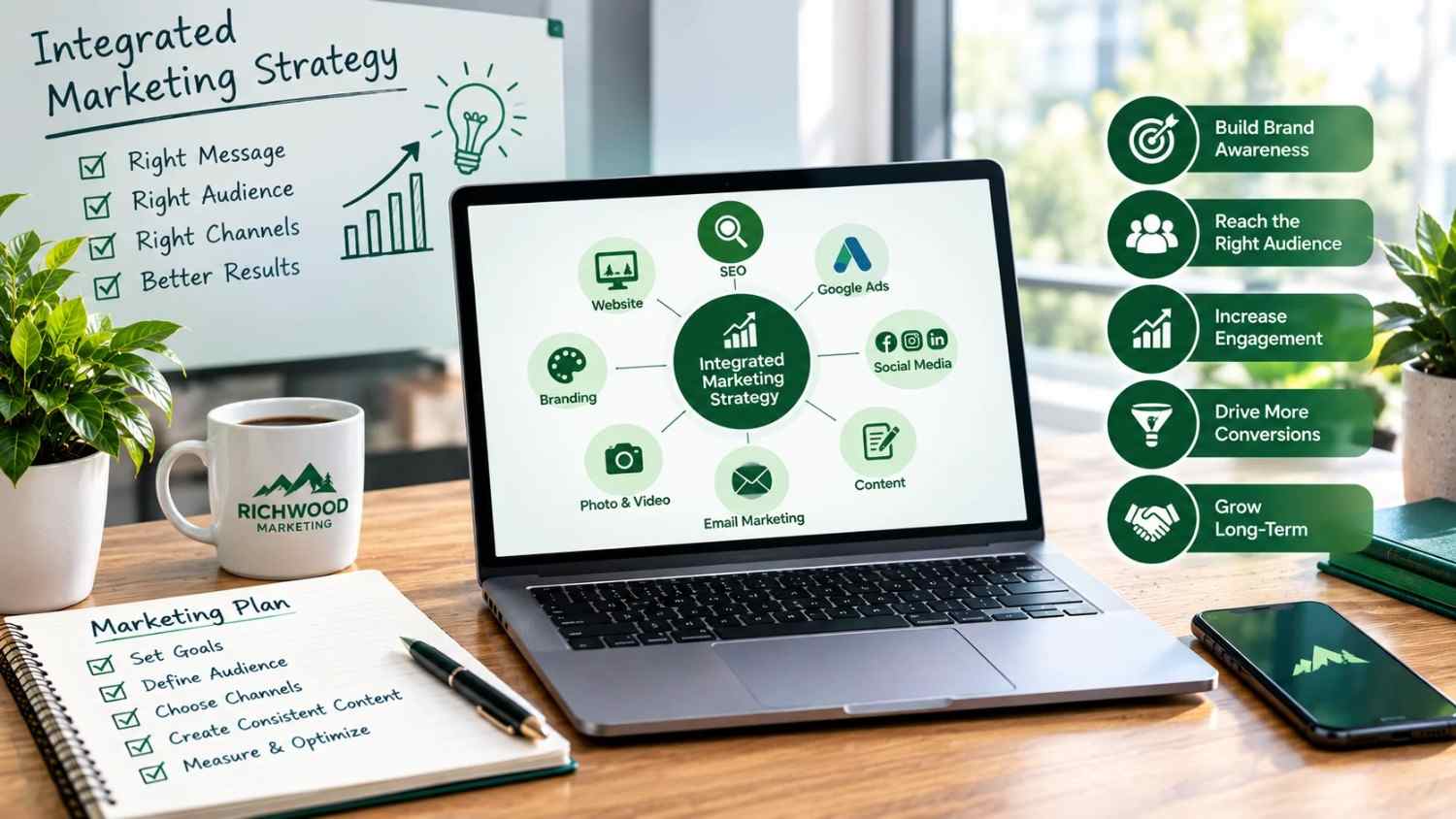
An integrated marketing strategy for small business is a coordinated plan that connects all your marketing channels SEO, Google Ads, social media, email, content, and local search so they reinforce each other rather than operating as disconnected tactics. Businesses using three or more channels see a 287% higher purchase rate than those using a single channel. 73% of consumers use multiple channels during the purchase journey, making single-channel strategies statistically insufficient. The build sequence for Ohio small businesses: start with two to three core channels where your customers are most active, establish consistent brand messaging across all of them, connect your analytics so every channel is measured against the same conversion goals, and expand channels only after the foundation is producing measurable results.
Most Ohio small businesses are already doing marketing. They are posting on social media. Running a Google Ad here and there. Publishing an occasional blog. Managing a Google Business Profile. But these activities are happening in parallel, not in concert and the difference between parallel marketing and integrated marketing strategy for small business is the difference between scattered activity and compounding growth.
Many small businesses are already doing plenty of marketing, they’re just doing it in pieces. A social post here, a flyer there, an email campaign somewhere in between. In 2026, the businesses seeing the best results are the ones connecting everything.
An integrated marketing strategy does not mean doing more. It means making everything you already do work together so your SEO content amplifies your Google Ads, your email list captures visitors your social media attracts, and your Google Business Profile reinforces every piece of content you publish. When all channels point in the same direction with the same message, the compounding effect produces results that no individual channel can achieve alone.
This guide walks through exactly how to build that integrated system for your Ohio small business from defining your foundation to choosing your core channels to measuring the full-picture performance that proves the strategy is working.
As the marketing team supporting Richwood Marketing’s Digital Marketing services for Richwood Bank business customers across central Ohio, we build integrated strategies for businesses in Marysville, Delaware, Bellefontaine, Marion, and the surrounding communities every day and the framework in this guide is the same one we apply.
What Is an Integrated Marketing Strategy And Why It Matters for Small Businesses
Integrated digital marketing means connecting your digital marketing channels so they work as one system, not separate tactics. In 2026, that matters more because AI search, privacy changes, and multi-screen behavior have made the customer journey harder to track and easier to lose.
The distinction matters practically. Here is what disconnected marketing looks like for a typical Ohio small business:
- Your SEO team (or you) is creating blog content around service keywords
- A separate vendor is running Google Ads with completely different messaging
- Your social media posts are visual and brand-focused, with no connection to the blog or ads
- Email marketing goes out monthly but does not reference what you published or advertised
- Your Google Business Profile is largely static
Each channel does something in isolation. None of them make the others stronger. A visitor who sees your Google Ad, then visits your website, then looks for your blog, then checks your social media encounters four different versions of your brand with four different messages. That fragmentation erodes trust and reduces the conversion rate at every step.
Today’s customers expect smooth, cohesive experiences across web, social, in-person, and print touchpoints. Fragmented messaging results in missed opportunities and eroded trust. An integrated strategy ensures your brand is recognizable, memorable, and preferable to competitors.
An integrated marketing strategy connects those channels with:
- Consistent messaging the same value proposition, the same tone, the same key benefits across every channel
- Shared audience data so you know which channels are generating the same customers, not just separate audiences
- Coordinated campaign timing blog content published before a Google Ads campaign launches, email campaigns supporting organic SEO pushes
- Unified measurement analytics configured to attribute leads across the full journey, not per-channel in isolation.
Step 1: Define Your Core Marketing Foundation Before Choosing Channels
An integrated marketing strategy is a comprehensive plan that unifies digital and traditional marketing channels to deliver a consistent, customer-focused message wherever your audience interacts with your business.
That message consistency starts with defining three things before touching any channel:
Your target customer: Not “small businesses in Ohio” but specifically the Richwood Bank business customer running a five-person home services company in Marysville, or the dental practice owner in Delaware expanding from one location to two. The more specifically you define who you are talking to, the more precisely every channel can speak to them.
Your core value proposition: The one statement that explains why your business specifically, for this customer specifically. This statement becomes the headline of your website, the hook of your Google Ad, the caption of your social post, and the subject line of your email slightly adapted per format, but fundamentally the same message.
Your conversion goal: What does success look like at the end of every marketing interaction? A phone call? A form submission? A booked appointment? Every channel’s measurement framework is built backward from this single agreed-upon conversion action.
Without these three foundations agreed upon first, every channel strategy you build will pull in a slightly different direction producing the fragmentation that makes integrated marketing impossible even when all the channels are technically present.
Step 2: Choose Two to Three Core Channels and Build Depth Before Breadth
Start with two to three primary channels where your audience is most active, then expand. Mastering two channels consistently outperforms shallow presence on six. Most small businesses should start with SEO and email for B2B, or social media and email for B2C, before adding paid advertising as a third channel.
For Ohio local service businesses specifically, the highest-impact starting channel combination is:
Channel Stack 1 Local service businesses (HVAC, plumbing, dental, legal):
- Local SEO + Google Business Profile (foundation captures active purchase intent)
- Google Ads Search (immediate lead generation while SEO builds)
- Email marketing (retention and referral for existing customers)
Channel Stack 2 Retail, restaurants, visual businesses:
- Social media (Instagram, Facebook) community and discovery
- Google Business Profile (local search and reviews)
- Email marketing (repeat purchase and loyalty)
Channel Stack 3 B2B professional services:
- SEO content + blog (topical authority for considered purchase research)
- LinkedIn (professional community and brand presence)
- Email nurture (long sales cycle relationship maintenance)
Small businesses can effectively approach multi-channel marketing by concentrating on a select few channels where their target audience is most active, ensuring consistent messaging across all platforms. The failure mode to avoid: adding channels because they seem popular rather than because your specific Ohio customers are actively discovering businesses through them.
Step 3: Create the Content Infrastructure That Feeds Every Channel
This is the operational core of an integrated marketing strategy for small business and where most businesses either build genuine leverage or stay stuck in constant content creation overwhelm.
The model: one piece of primary content (typically a blog post or video) feeds every other channel simultaneously.
Your copy, visuals, and tone should support the same brand across your website, ads, email, and social. This builds brand awareness and makes campaigns easier to remember.
The integrated content loop for an Ohio small business:
- Publish a blog post targeting a keyword your Ohio customers search (e.g., “how to choose an HVAC company in Marysville Ohio”)
- Share on social media 3–5 captions extracted from the post’s key points, scheduled over two weeks
- Create a GBP post a single tip or statistic from the article, linked back to the post
- Send to email list a 150-word summary with a link to read the full post
- Use as Google Ads landing page if the keyword has commercial intent, run a targeted search ad to the optimized post
- Internal link from related service pages connect the blog post to your relevant Ohio service or location page
One piece of content produced five distribution touchpoints. Each touchpoint drives to the same destination, builds the same brand familiarity, and converts the same customer across whichever channel they happen to be using when they encounter it.
The content creation and SEO work Richwood Marketing handles for Ohio clients is built around this exact loop so every piece of content produced earns multiple simultaneous distribution payoffs rather than a single-channel appearance.
Step 4: Align Your Messaging Across Every Channel
Key distinction: Multi-channel marketing uses multiple platforms without coordination each channel runs its own strategy. Integrated marketing prioritizes message unity and strategic alignment all channels reinforce the same core narrative.
Message alignment does not mean identical content on every platform. It means:
- The same value proposition expressed in the format appropriate to each channel
- The same visual brand colors, fonts, logo placement consistent across website, social, email, and ads
- The same seasonal and campaign themes running simultaneously across all active channels
- The same tone a business that is warm and community-focused in its blog posts should not be formal and corporate in its email subject lines
A practical alignment check: if you show someone your Google Ad, your Instagram post, your homepage, and your email newsletter side by side do they look and feel like they came from the same business? If any of the four feels disconnected, that is where message fragmentation is undermining your integrated strategy.
Step 5: Measure Integrated Performance Not Per-Channel in Isolation
Data-informed optimization is one of the core principles of integrated marketing communications. By analyzing campaign results, you learn what resonates with audiences and refine messaging accordingly. Instead of analyzing every metric possible, focus on those that track conversions.
The most common measurement mistake in integrated small business marketing: evaluating each channel against its own platform metrics rather than against the shared conversion goal.
Social media analytics say engagement is up. Email shows a 30% open rate. Blog traffic is growing. Google Ads shows a declining cost per click. But none of these platform metrics tell you what matters: how many qualified leads and phone calls did the combined system produce this month, and which channels contributed to the customers who converted?
To measure multi-channel marketing performance effectively, track key metrics such as conversions and ROI across all channels. Utilize unified analytics tools to consolidate data and regularly analyze performance to optimize your marketing mix for improved results.
For Ohio small businesses, a practical measurement framework:
- Primary metric: Leads or calls generated per month (total, not per channel)
- Attribution data: Which channel appears in Google Analytics as the source for converting sessions
- Assisted conversions: Which channels appear earlier in the path before a conversion these are supporting channels that may look “low performing” in last-click attribution but are actually essential
- Channel health metrics: Each channel’s internal KPI (organic traffic for SEO, ROAS for Google Ads, open rate for email) tracked separately as health indicators, not as the primary success measure
How Richwood Marketing Builds Integrated Strategies for Ohio Small Businesses
At Richwood Marketing, the integrated marketing conversations we have with Richwood Bank business customers across central Ohio consistently reveal the same gap: businesses doing the right activities across multiple channels but measuring them in isolation, messaging them inconsistently, and missing the compounding gains that connected channels produce.
Businesses that automate across multiple channels generate 80% more leads and see 77% higher conversion rates. For an Ohio service business with a modest marketing budget, the automation does not need to be sophisticated a simple email sequence that triggers after a website form submission, a GBP posting schedule aligned to blog publication dates, and a Google Ads retargeting campaign that shows to visitors who read your blog but did not convert. These connections require minimal technology and produce measurable compounding results.
According to the American Marketing Association’s 2026 guidance on integrated marketing, the most successful small business marketing programs share one structural characteristic: every channel investment feeds the same customer journey rather than competing for attention within it.
Discover our full range of services at Richwood Marketing to see how our integrated digital marketing approach covering SEO, Google Ads, content, local search, social media, and email is built as one connected system for Ohio small businesses rather than a menu of disconnected options.
Integrated Marketing Strategy Decision Guide: Where to Start
| Your Current Situation | First Priority | Second Priority | Third Priority |
| No active digital marketing at all | Local SEO + GBP | Website copy + content | Email list building |
| Active on social, no SEO | SEO foundation | Connect social to blog | Email list from social |
| Running Google Ads, no organic | Local SEO + content | Email nurture for paid leads | Social for brand awareness |
| Consistent content, no email list | Email capture + welcome sequence | Connect content to GBP | Add Google Ads for top content |
| All channels active, not connected | Unified messaging review | Shared analytics setup | Content loop integration |
Frequently Asked Questions
What is an integrated marketing strategy for a small business?
An integrated marketing strategy is a comprehensive plan that unifies digital and traditional marketing channels such as SEO, social media, email marketing, and in-person experiences to deliver a consistent, customer-focused message wherever your audience interacts with your business. Every channel reinforces the others rather than operating independently.
How many marketing channels should a small Ohio business use?
Start with two to three primary channels where your audience is most active, then expand. Mastering two channels consistently outperforms shallow presence on six. For most Ohio local service businesses, the right starting combination is local SEO plus Google Ads, with email added as the third channel once both are producing leads.
What is the difference between multichannel and integrated marketing?
Multi-channel marketing uses multiple platforms without coordination each channel runs its own strategy. Integrated marketing prioritizes message unity and strategic alignment all channels reinforce the same core narrative. The difference is whether your channels are coordinated or independent.
How long does it take to see results from an integrated marketing strategy?
Google Ads produces leads within days of launch. Local SEO takes 3–6 months to build meaningful rankings. Email marketing shows returns within 30–60 days of list building. An integrated strategy compounds these timelines by month six of consistent, connected execution, most Ohio small businesses see significantly stronger combined results than any channel would produce independently.
What budget does a small business need for an integrated marketing strategy?
Research consistently shows businesses that focus on a core channel stack and build depth produce better results than those that spread budget across many platforms simultaneously. Start by funding your two to three core channels properly rather than distributing a small budget across six channels that cannot generate results at low investment levels.
How do I measure whether my integrated marketing strategy is working?
Focus on metrics that track conversions. Analytics also indicate which channels get the best results, allowing you to focus on those with the best return on investment. Track total leads and calls generated monthly as your primary metric, with channel-level health metrics (organic traffic, ROAS, open rates) as secondary indicators of each channel’s individual performance.
Conclusion: Integrated Marketing Is the Strategy That Makes Every Channel Work Harder
Building an integrated marketing strategy for your small business is not about doing more marketing. It is about making the marketing you are already doing produce compounding returns by connecting it into one coordinated system with consistent messaging, shared measurement, and channels that feed each other rather than competing for the same limited budget and attention.
The Ohio small businesses generating the strongest, most consistent lead flow in 2026 are not the ones spending the most. They are the ones whose SEO, Google Ads, email, social media, and local search all carry the same message to the same customer across every touchpoint that customer encounters on the path from awareness to conversion.
Talk to a Richwood Marketing strategist about building an integrated marketing strategy for your Ohio business we will audit your current channel mix, identify where connections are missing, and build the coordinated plan that turns your existing marketing investment into a system that compounds.
