

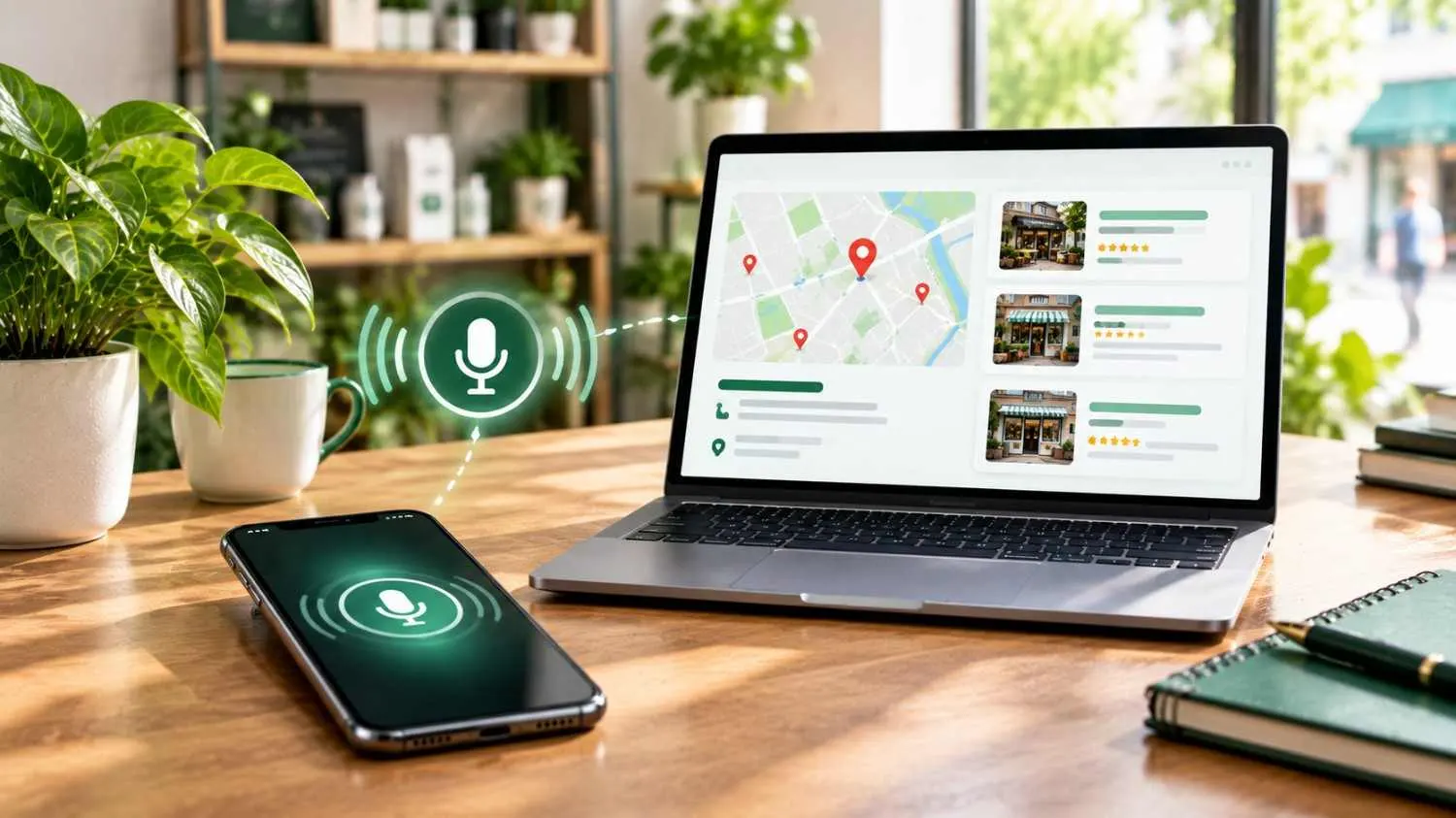
If a customer asks their phone, “Who is the best electrician near me?”, your business either gets named or it does not exist. That is the shift behind voice search local SEO for small business. Spoken searches are conversational, they are heavily local, and they reward businesses with accurate listings, helpful answers, and strong reviews. You do not need a new website to win them. You need a sharper version of the local SEO foundation you should already have.
In this guide, we explain how voice search is changing local SEO, how customers actually use it, which voice search ranking factors matter, and the exact steps to optimize your business. At Richwood Marketing, our Digital Marketing services help Central Ohio business owners turn this kind of search behavior into calls and visits. Richwood Marketing services are available to Richwood Bank business customers across our nine-community branch footprint.
What Is Voice Search Local SEO for Small Business Owners?
Voice search local SEO is the practice of optimizing your online presence so voice assistants (Google Assistant, Siri, Alexa, and in-car systems) choose your business when someone asks a local question out loud. It combines classic local SEO for small businesses with voice search optimization: natural-language content, structured data, and accurate listings.
The key difference is the output. A typed search shows a page of results. A spoken search often returns one business, read aloud, with an offer to call or navigate. That makes voice search and local SEO a winner-takes-most game, which is why the basics matter more than tricks.
Explore Richwood Marketing’s services to see how local visibility connects to the rest of your marketing, from your website to your ads.
How Voice Search Is Changing Local SEO: 5 Major Shifts
Here is how voice search is changing local SEO compared with typed search:
| Factor | Typed local search | Voice local search |
| Query style | “plumber Marysville OH” | “Who is the best plumber near me that’s open now?” |
| Length | 2-4 words | Often 6+ words, full questions |
| Results | 10 links plus a map pack | Usually 1 spoken answer |
| Intent | Research or compare | Immediate: call, visit, get directions |
| Device | Desktop and mobile | Mostly phones, smart speakers, cars |
The five shifts to plan around:
- Conversational search queries replace keywords. People speak in questions, so your content must too.
- Near me voice searches dominate. Proximity, hours, and “open now” signals decide who is named.
- Fewer winners. Being third on the map pack matters less when only one business is read aloud.
- Mobile first. Most voice searches happen on a phone, so mobile SEO for local businesses is non-negotiable.
- Trust signals decide ties. Reviews, consistent listings, and a complete profile separate similar businesses.
How Customers Use Voice Search to Find Local Businesses
Understanding how customers use voice search to find local businesses tells you what to build. Typical spoken queries include:
- “Coffee shop near me open right now”
- “Does the hardware store in Delaware, Ohio have snow blowers?”
- “What time does the dentist close today?”
- “Call the closest tire shop”
- “Best restaurants near me with outdoor seating”
Industry surveys, including widely cited BrightLocal research, have reported that a majority of consumers (roughly 58% in commonly cited figures) have used voice search to find local business information, and that many go on to call or visit. Exact percentages vary by study and year, so treat them as directional. The pattern is consistent: voice searchers are close to a decision. They want an address, a phone number, or an answer, not a research project.
In our work with small businesses across Central Ohio, the businesses that get named for “near me” style questions are rarely the ones with the flashiest sites. They are the ones with complete profiles, consistent details, and recent reviews.
Voice Search Ranking Factors for Local Voice Search Optimization
No one outside Google or Apple publishes an official list, but studies and practical testing point to these voice search ranking factors for local queries:
- Proximity. How close you are to the searcher.
- Profile completeness. Category, hours, services, photos, attributes.
- Listing consistency. Matching name, address, and phone across directories.
- Reviews. Quantity, recency, rating, and how you respond.
- Concise, structured answers. Content that directly answers a question in 30-50 words.
- Page speed and HTTPS. Fast, secure mobile pages are favored.
- Schema markup. LocalBusiness and FAQ structured data help machines understand you.
- Overall authority. Voice answers frequently come from pages that already rank well in the top results.
This is also why answer-first writing works for AI search. Our guide on answer-first content that earns AI Overview visibility covers that side in depth.
How to Optimize Local SEO for Voice Search: 7 Steps
- Optimize Google Business Profile for Voice Search
Your Google Business Profile is the single biggest lever for Google voice search optimization. Choose the most accurate primary category, add secondary categories, list services, write a clear description, set holiday hours, upload real photos, and turn on messaging if you can answer quickly. Google explains how profile relevance, distance, and prominence affect rankings in its guide to improving your local ranking on Google. If you want a team to handle this, our local SEO for small businesses service covers profile setup, listings, and reviews.
- Keep Local Voice Search Details Consistent
Voice assistants cross-check multiple sources, including Google, Apple Maps, Bing, and Yelp. A mismatched phone number or old suite number can cost you the answer. Audit your name, address, phone, hours, and website everywhere.
- Write for Conversational Search Queries and Natural Language Search
Add FAQ sections to service and location pages that mirror how people talk: “How much does a furnace tune-up cost in Springfield?” Give a direct answer first, then detail. Professional content creation for conversational search queries makes this repeatable across your site.
- Add Structured Data for SEO for Voice Assistants
Use LocalBusiness, OpeningHoursSpecification, and FAQPage schema so assistants can read your details with confidence. Our structured data and on-page SEO work handles this alongside titles, headings, and internal links.
- Strengthen Mobile SEO for Local Businesses
Aim for pages that load quickly on a phone, have tap-to-call buttons, and show your hours without scrolling. A mobile-friendly website design removes the friction that loses voice-driven visitors.
- Earn Reviews That Support Voice Search and Local SEO
Ask every happy customer for a review, reply to all of them, and encourage details like the service and town. Natural review language reinforces what you do and where.
- Build Near Me Voice Search Pages
Create a page for each real service area, with local landmarks, directions, parking details, and community-specific questions. Do not duplicate text between towns.
Voice Search Optimization vs Traditional Local SEO: A Decision Guide
You do not choose one over the other. Use this guide to decide where to start:
| Your situation | Start here | Why |
| No Google Business Profile or incomplete one | Profile and listings | Fastest path to being named |
| Profile is solid, few reviews | Review generation | Reviews break ties |
| Good profile, thin website | FAQ and service page content | Feeds conversational queries |
| Slow or non-mobile site | Mobile and speed fixes | Voice users are on phones |
Benefits of Voice Search for Small Businesses
The benefits of voice search for small businesses are practical:
- High-intent leads. Spoken local queries often end in a call or a visit.
- Less competition. Many competitors have not optimized for spoken questions yet.
- Compounding value. The same work improves your map pack, website, and AI search visibility.
- Better customer experience. Accurate hours and clear answers reduce wasted trips and missed calls.
Common Voice Search Optimization for Local Businesses Mistakes
- Writing stiff, keyword-stuffed copy instead of natural answers.
- Ignoring hours updates around holidays.
- Letting duplicate or outdated listings stay live.
- Targeting vague “best” claims with no proof.
- Forgetting that voice results depend on trust, not just content.
How to Measure Voice Search Local SEO Results
Voice searches are not labeled separately in most tools, so track the outcomes: Google Business Profile calls, direction requests, and website clicks; “near me” and question-style queries in Search Console; and tracked phone calls. Review them monthly alongside the digital marketing KPIs for small business that matter most.
Voice Search Strategies for Small Business Owners: Our Recommendations
Recommendation 1 (start today): Verify and complete your Google Business Profile. This takes an hour and affects every voice assistant that uses Google data.
Recommendation 2 (this month): Add a 5-question FAQ to your top service page, with direct answers under 50 words.
Recommendation 3 (this quarter): Build a steady review routine: one ask after every completed job or sale.
If you want a local team to run this with you, Start the conversation, contact us and we will review your profile, site, and local competition together.
Frequently Asked Questions About Voice Search and Local SEO
What is voice search in local SEO?
Voice search in local SEO is optimizing your business so assistants like Google Assistant, Siri, and Alexa recommend you when someone speaks a local question, such as “find a florist near me.”
How does voice search affect local SEO?
It makes queries longer and more conversational, raises the importance of “near me” intent, and often returns a single answer. Profile accuracy, reviews, and mobile speed matter more as a result.
How do I optimize my business for voice search?
Complete your Google Business Profile, keep listings consistent, add FAQ content in natural language, use LocalBusiness schema, speed up your mobile site, and collect reviews regularly.
Does Google Business Profile help with voice search?
Yes. It is a primary data source for Google Assistant. Accurate categories, hours, services, and reviews directly influence which business is named.
How is voice search different from typed search?
Voice queries are longer, phrased as questions, and more local, and they usually produce one spoken answer instead of a list of links.
Is voice search worth it for small businesses?
Yes, because the work overlaps with core local SEO. The same profile, content, and review improvements raise your visibility in maps, organic results, and voice answers.
What are near me voice searches?
They are spoken requests for nearby businesses, like “pizza near me” or “closest pharmacy open now.” Proximity, hours, and ratings decide the result.
How do voice assistants choose which local business to recommend?
They weigh distance, relevance to the question, listing accuracy, reviews, and the authority of sources they pull from. No single factor guarantees the answer.
Final Thoughts
Voice search local SEO for small business is not a separate discipline. It is local SEO done accurately, answered conversationally, and backed by reviews. Start with your profile, then your content, then your mobile experience, and measure calls and directions as your real scorecard. If you are a Richwood Bank business customer and want help, our team is ready to build the plan with you.
