

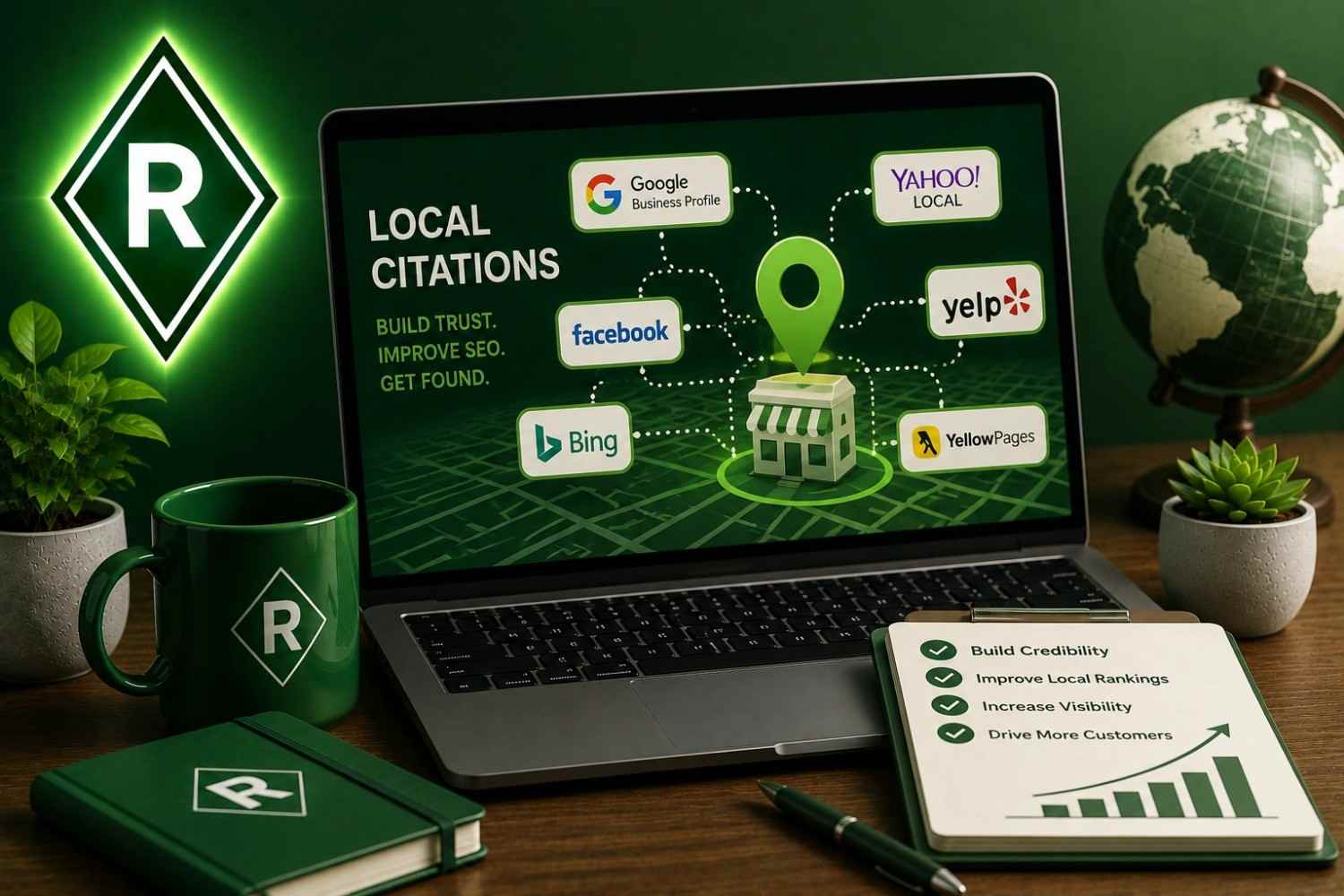
Local citations are online mentions of your business’s Name, Address, and Phone number (NAP) across directories, websites, platforms, and apps beyond your own website. Search engines use citations to verify business legitimacy and determine local search rankings. Quality matters more than quantity. Most businesses should aim for 40–60 high-quality citations across authoritative general directories, industry-specific platforms, and local sources. In 2026, citations matter for two distinct reasons: they influence traditional Google Maps rankings, and they determine how AI search engines like ChatGPT, Perplexity, and Google AI Mode describe your business to users asking local questions. Inconsistent or incorrect citation data a wrong phone number, a misspelled address, or an outdated suite number tells Google the information cannot be trusted, which directly suppresses local pack visibility.
Ask most Ohio small business owners what a local citation is, and they will likely give you a blank look. Ask the same business owner why their Google Maps ranking dropped after they moved to a new office last year, and you have found the exact problem that citations cause when they go wrong.
What are local citations in SEO? They are the foundational verification layer that Google uses to decide whether your business is real, legitimate, and worthy of appearing in local search results. Simply put, SEO citations are online mentions of your business name, address, and phone number. These mentions can appear on business directories, local websites, social platforms, review sites, and even blog posts. Search engines use this information to confirm that your business is real, trustworthy, and located where you say it is.
When every mention of your Ohio business online says the same thing, the same name, the same address formatted the same way, the same phone number Google’s confidence in your business data grows. That confidence translates directly into higher local pack rankings, better Google Maps visibility, and more customers finding you when they search for the services you provide.
For Ohio small businesses managing their own local SEO or working with an agency, professional Off-Page SEO services in Central Ohio include citation building, citation auditing, and ongoing citation management as core deliverables because without consistent citations, every other local SEO investment produces weaker results than it should.
What Exactly Are Local Citations? The Complete Definition
Local citations are online mentions of your business’s name, address, and phone number (NAP) across directories, websites, and platforms beyond your own. Google Business Profile is the most important citation source, but your business information lives on dozens, sometimes hundreds of other platforms: Yelp, Apple Maps, Bing Places, Facebook, Yellow Pages, data aggregators, and niche industry directories.
Citations exist in two distinct forms, and understanding both helps you build a complete citation strategy:
Structured citations are formal, standardized listings in business directories and platforms with dedicated fields for your business name, address, phone, hours, website, and categories. Examples: Google Business Profile, Yelp, BBB, Angi, Yellow Pages, Facebook Business, Apple Maps, Bing Places. These are the highest-value citations because they appear on platforms Google actively cross-references when verifying business data.
Unstructured citations are organic mentions of your business information within regular web content, a news article about a local business award, a blog post recommending your services, a community events page listing your address. These carry less individual weight than structured directory citations, but they contribute to the total web footprint of consistent business data that Google evaluates.
Both types contribute to what Google’s algorithm measures when evaluating whether your business deserves to rank prominently in local search results for your Ohio community.
Why Local Citations Matter for SEO in 2026: Two Critical Reasons
The role of local citations in SEO has evolved significantly. Citations have become part of the verification layer that decides whether a business is trusted enough to be shown at all, especially in AI-generated local answers. That’s why many businesses now rely on citation building not to chase volume, but to maintain clean, consistent, verifiable business data across the platforms machines actually trust.
Reason 1: Google’s Local Ranking Algorithm Uses Citations to Verify Legitimacy
Local citation volume and consistency consistently appear among the top ranking factors in the annual Moz Local Search Ranking Factors survey. Citations continue to serve as fundamental verification signals that tell Google a business is real, established, and operating at a specific location.
When Google evaluates which businesses to show in the local pack for a search like “HVAC repair near Marysville Ohio,” it cross-references your Google Business Profile data against dozens of other sources: Yelp, Apple Maps, Bing Places, BBB, industry directories, and data aggregators. When all those sources agree on your business name, address, and phone number, Google’s confidence in your data increases and your local pack ranking improves accordingly.
When they disagree when your address shows a different suite number on three platforms, or your phone number is outdated on a directory you never claimed, each discrepancy sends Google a conflicting signal. Instead of confirming “this is the same business,” the data says “these might be different businesses or one of these might be wrong.” Google’s response is to rank you lower in local pack results.
Reason 2: Citations Now Train the AI Systems That Surface Local Business Recommendations
ChatGPT’s local search features went mainstream in February 2026. Perplexity launched business recommendations. Claude added location-based queries. Suddenly, citations weren’t just feeding Google’s algorithm, they were training AI models that millions of people use daily.
When someone asks ChatGPT or Perplexity “recommend a good plumber in Delaware, Ohio,” those AI systems pull from the same web data that Google indexes including your business directory listings, your NAP information, and your review content. Businesses with clean, consistent, complete citation profiles appear in AI-generated local recommendations. Businesses with inconsistent data are omitted or misrepresented.
For Ohio small businesses competing in local markets in 2026, this means citations are no longer just a Google ranking factor, they are a prerequisite for visibility in the AI-driven local discovery landscape.
Why NAP Consistency Is the Single Most Important Citation Factor
NAP stands for Name, Address, Phone and consistency across every place your business appears online is the foundation of an effective local citation strategy.
Total consistency matters: spelling, abbreviations (St vs Street), phone formatting, and domain format must align across all citation sites. When address information differs between Google and a business website, many potential customers lose trust and move on to a competitor instead.
Here is how inconsistency typically appears for Ohio small businesses:
| Citation Element | Inconsistency Example | What It Signals to Google |
| Business name | “Harris Plumbing” vs “Harris Plumbing LLC” vs “Harris Plumbing Co.” | Possible different businesses |
| Address format | “123 Main St” vs “123 Main Street” vs “123 Main St.” | Possible different locations |
| Suite/unit number | Suite 200 vs Ste. 200 vs (missing entirely) | Uncertainty about address |
| Phone number | (740) 268-4182 vs 740-268-4182 vs 7402684182 | Data reliability question |
| Website URL | richwoodmarketing.com vs www.richwoodmarketing.com | Inconsistent entity signal |
When there are discrepancies, even minor ones, it triggers verification flags that can suppress local rankings. Standardizing your NAP across every citation source using one exact format for every element, consistently is the foundational fix before any citation building begins.
The Most Important Citation Sources for Ohio Small Businesses
Not all citations are created equal.Citation quality now matters more than raw quantity. A business with 50 accurate, consistent citations on high-authority platforms will typically outperform one with 200 low-quality or inconsistent citations from irrelevant directories.
Tier 1 Critical citations every Ohio business must have:
- Google Business Profile The single most important citation source for local SEO. Google Business Profile is the anchor of your citation strategy, not the entirety of it. Your GBP listing is most powerful when supported by a broad ecosystem of corroborating citations on other platforms.
- Apple Maps Critical as Apple’s Siri uses it for voice search results across all iOS devices
- Bing Places Microsoft’s local search, increasingly important for Bing AI integration
- Yelp High domain authority, widely trusted by consumers and Google
- Facebook Business Social citation with strong local relevance signals
Tier 2 High-authority general business directories:
- Better Business Bureau (BBB)
- Yellow Pages (yellowpages.com)
- Angi (formerly Angie’s List) especially important for home service businesses
- Foursquare / Swifty
- MapQuest
Tier 3 Ohio-specific and industry-specific directories:
- Ohio Chamber of Commerce directory
- Local city and county Chamber of Commerce directories (Union County, Logan County, Delaware County)
- Industry-specific directories relevant to your business category
- Local newspaper business directories (The Columbus Dispatch, Marion Star, etc.)
- Data aggregators: Data Axle, Neustar Localeze, Foursquare these feed hundreds of downstream directories automatically
For Richwood Bank business customers and Ohio small businesses in our nine-community central Ohio footprint, local and regional directories carry particular weight because geographic-specific citations send stronger local relevance signals than generic national directories for businesses competing in defined local markets.
How to Build Local Citations for an Ohio Small Business
Prioritize in this order: fix your website and Google Business Profile first, then build local citations, then focus on ongoing content and link acquisition.
Step 1 Establish your canonical NAP: Before building any new citations, decide on the exact format of your business name, address (including suite, if applicable), and phone number. Write it down. This exact format is what you will use everywhere, no variations.
Step 2 Audit existing citations: Use a tool like BrightLocal, Whitespark, or Moz Local to find every place your business already appears online. Identify all inconsistencies. Correct them before adding new citations because adding new consistent citations on top of existing inconsistent ones does not cancel out the conflicting signals.
Step 3 Claim and complete Tier 1 citations: Start with Google Business Profile, Apple Maps, Bing Places, Yelp, and Facebook Business. Claim, verify, and fully complete every profile including hours, website, categories, description, and photos.
Step 4 Build Tier 2 and Tier 3 citations systematically: Submit to BBB, Yellow Pages, Angi, and the general directory list. Then identify and submit to Ohio-specific and industry-specific directories relevant to your business type. Target 40–60 high-quality, relevant citations for most Ohio small businesses.
Step 5 Use data aggregators for scale: Submitting to major data aggregators Data Axle, Neustar Localeze, Foursquare ensures your corrected NAP data propagates automatically to hundreds of downstream directory sites that pull from these sources. This is the most efficient way to correct citation data at scale.
Step 6 Monitor and maintain ongoing: Conduct citation audits at 3–6 month intervals to keep citations and trust signals accurate Any business change address, phone number, business hours, ownership requires immediate citation updates across every platform. Failing to update citations after an address change is one of the most common causes of local ranking drops for established businesses.
How Citation Issues Hurt Ohio Small Businesses: Real Patterns We See
At Richwood Marketing, citation problems are among the most common local SEO issues we find when auditing accounts for Richwood Bank business customers across Marysville, Delaware, Bellefontaine, Marion, Plain City, Urbana, and the surrounding central Ohio communities.
The pattern is consistent: a business moved locations two years ago and updated their Google Business Profile but never claimed and updated their Yelp, Apple Maps, or BBB listings. Or a business changed their phone number during a rebrand and updated their website but missed the 35 directory listings where the old number still appears. Or a business has three different slight variations of their name across platforms because different employees submitted the listings at different times with no standardized format.
Mismatched or outdated citations directly lead to lost visits, negative reviews, and reduced conversions not just lower rankings Customers who find the wrong address drive to the wrong location and leave frustrated reviews. Customers who find the wrong phone number cannot reach you. Both outcomes are completely preventable with consistent citation management.
According to Moz’s Local Search Ranking Factors Study, citation signals including consistency, volume on quality sources, and category relevance remain among the most impactful local ranking factors that businesses can directly control. Unlike backlinks or review volume, which depend on external behavior, citation accuracy is entirely within your control.
Learn more about our marketing services including how citation management fits into Richwood Marketing’s complete local SEO approach for Ohio small businesses covering everything from GBP optimization and local link building to on-page SEO and technical foundations.
Local Citations vs Backlinks: Understanding the Difference
| Factor | Local Citations | Backlinks |
| Primary purpose | Verify business legitimacy and location | Build domain authority and topical trust |
| What they contain | NAP data (Name, Address, Phone) | Linked URL with anchor text |
| Where they appear | Directories, platforms, apps | Editorial content on other websites |
| Impact on local rankings | Direct especially for Google Maps | Indirect through domain authority signals |
| Quantity target | 40–60 quality sources | As many quality, relevant links as possible |
| Management requirement | Ongoing accuracy maintenance | Ongoing acquisition and monitoring |
| Speed of ranking impact | 30–90 days for corrections to propagate | 60–180 days typically |
Both are important for complete local SEO. Citations verify that your business is real and located where you claim. Backlinks build the domain authority that determines how trustworthy your website is. Neither replaces the other strong Ohio small businesses that need both working together.
Recommendation Block: Citation Priorities for Ohio Businesses by Type
| Business Type | Most Critical Citation Sources | Industry Directories to Add |
| Home Services (HVAC, Plumbing, Roofing) | GBP, Angi, BBB, Thumbtack | HomeAdvisor, Porch, Houzz |
| Healthcare / Dental | GBP, Healthgrades, WebMD, ZocDoc | Vitals, CareDash, physician directories |
| Legal / Professional Services | GBP, Avvo, FindLaw, Martindale | State bar directory, LinkedIn |
| Restaurant / Food Service | GBP, Yelp, TripAdvisor, OpenTable | Zagat, Zomato, Grubhub listings |
| Retail / E-commerce | GBP, Facebook, Yelp | Industry trade directories, Google Shopping |
| Real Estate | GBP, Zillow, Realtor.com, Trulia | Local MLS, Chamber of Commerce |
| Financial Services / Banking | GBP, BBB, Yelp | Industry regulatory directories, FDIC |
| Automotive | GBP, Yelp, Carfax, AutoTrader | NADA, local dealer directories |
Frequently Asked Questions
What are local citations in SEO?
Local citations are online mentions of your business name, address, and phone number that appear on business directories, local websites, social platforms, review sites, and content across the web. Search engines use this information to confirm that your business is real, trustworthy, and located where you say it is.
How many citations does a small business need for local SEO?
Most businesses should aim for 40–60 high-quality citations across authoritative general directories, industry-specific platforms, and local sources. Focus on consistency and relevance rather than building hundreds of low-quality citations. Quality and accuracy at 50 citations outperforms volume at 200 inconsistent ones.
Does citation consistency really affect Google Maps rankings?
Yes, each discrepancy in your NAP data sends Google a conflicting signal. Instead of confirming your business identity, inconsistencies create doubt that Google resolves by ranking you lower in local pack results. Fixing NAP inconsistencies is one of the fastest ways to improve local pack visibility.
How often should a small business audit their local citations?
Conduct citation audits at 3–6 month intervals to keep citations and trust signals accurate. Additionally, any business change, new address, new phone number, updated hours, business name change should trigger an immediate citation audit and update across all platforms.
Do local citations still matter in 2026 with AI search?
Yes, citations have become part of the verification layer that decides whether a business is trusted enough to be shown at all, especially in AI-generated local answers. They were feeding Google’s algorithm, and now they’re training AI models that millions of people use daily.Clean citations matter more in 2026, not less.
What is the most important local citation source for Ohio small businesses?
Google Business Profile is the most important individual citation for local SEO, but it is far from the only one that matters. Your GBP listing is most powerful when it’s supported by a broad ecosystem of corroborating citations on other platforms. Apple Maps, Bing Places, Yelp, and BBB round out the highest-priority tier.
Conclusion: Local Citations Are the Verification Layer Every Ohio Business Needs
What are local citations in SEO? They are the web’s verification system for local businesses, the consistent, cross-platform confirmation that your business is real, located where you claim, reachable at the number you list, and operating under the name you use. Without that foundation, rankings, reviews, and even a perfect Google Business Profile struggle to compound into the local search visibility your Ohio business needs to capture leads consistently.
For Richwood Bank business customers and Ohio small businesses across central Ohio, citation accuracy is not a one-time project, it is ongoing infrastructure that requires maintenance when business details change and periodic auditing to catch new inconsistencies before they compound into ranking problems.
Request your free consultation with Richwood Marketing to get a citation audit for your Ohio business. We will find every inconsistency, identify every missing high-value directory, and build the citation profile that gives Google the confidence it needs to show your business to every local customer searching for what you offer.
