
The logo design process typically follows six stages: discovery and brief, research and strategy, concept sketching, digital development, client review and revisions, and final file delivery. Working with a professional designer takes 2–4 weeks for a single logo and 4–8 weeks for a full brand identity package. Clients should expect to provide a clear creative brief, give structured feedback on 2–3 initial concepts, and receive final files in multiple formats SVG, PNG, EPS, PDF for use across print and digital applications. The most important thing a client can do to speed up the logo design workflow is to come prepared with examples of logos they like, a clear description of their audience, and an understanding of where the logo will be used.
Most business owners who have never gone through a professional logo design process before walk into it with one of two misconceptions: they either think it will be fast and simple “just design me a logo” or they assume it will be an overwhelming, expensive, drawn-out process that requires twelve meetings and twelve rounds of revisions. The truth lands somewhere very different from both.
When you understand what actually happens at each stage of how logo design works from the designer’s side, you become a better client, the process moves faster, and the final result is significantly stronger. If you are a small business owner in central Ohio thinking about investing in a custom logo, this guide walks through every stage of what to expect from your first conversation with a designer to the moment you receive your final files.
Our logo design services for Ohio small businesses and Richwood Bank business customers follow exactly the process documented here built around clear communication, defined milestones, and a structured approach that produces a logo that actually works across every application, not just on a screen.
Why the Logo Design Process Matters Before a Single Sketch Is Made
A logo is not just art it is a business asset. Following a structured design process ensures your logo performs across every touchpoint, from your website to your business card to your vehicle wrap.
The businesses that end up with weak logos, the generic, forgettable, or misaligned ones almost always took shortcuts in the process. They skipped the brief, they asked for a logo without communicating their audience, or they picked the concept that looked “coolest” instead of the one that communicated the right message. Set expectations early with a tight brief and approval gates to keep the project on track and avoid delays. A good design process means doing the right steps in the right order so you stop redoing work.
Understanding the logo design workflow before you begin is what separates clients who get a logo they will use for ten years from clients who are back at square one in eighteen months.
Stage 1: Discovery The Logo Design Consultation
Every professional logo design process begins with a discovery conversation. This is not a sales call, it is a structured information-gathering session that gives the designer everything they need to make strategic decisions before picking up a pencil.
What your designer will ask during the logo design consultation:
- What does your business do, and who is your primary customer?
- What adjectives describe how you want customers to feel about your brand? (Professional, approachable, premium, playful, trustworthy?)
- Who are your main competitors, and how do you want to differentiate visually from them?
- Where will this logo be used? (Website, signage, uniforms, vehicle wraps, social media, packaging?)
- Are there any colors, styles, or visual directions you love or specifically want to avoid?
- Do you have any existing brand elements (color, font, tagline) that must be incorporated or respected?
The answers to these questions become your logo design brief, the single document that guides every creative decision that follows. A strong brief captures client needs early and lets you adjust fast, preventing the “just make it pop” feedback that derails timelines.
What you should bring to the consultation:
- 3–5 examples of logos you admire (they do not need to be in your industry)
- 2–3 examples of logos you dislike, with a brief note on why
- A clear description of your target customer
- Any existing brand colors, fonts, or visual assets already in use
The more specific and prepared you are at this stage, the faster and more accurately the designer can work.
Stage 2: Research and Brand Strategy
Before any concept is sketched, a professional designer conducts research. This is the stage most clients never see and it is often where the difference between a generic logo and a memorable one is made.
What happens in the research stage:
- Competitive analysis: reviewing what competitors’ logos look like so your logo can differentiate, not blend in
- Industry visual conventions: identifying which visual codes (color families, icon styles, typography moods) are standard in your sector and which ones are worth breaking
- Target audience research: understanding what visual cues resonate with the customers you are trying to attract
- Mood board development: collecting visual inspiration color, type, imagery tone that defines the aesthetic direction before any logo mark is created
This research phase is what makes professional logo design worth the investment over a five-dollar online logo generator. The generator cannot analyze your competition, understand your audience, or make strategic choices about visual differentiation. A professional designer does all three before drawing the first concept.
Stage 3: Logo Concept Sketching and Development
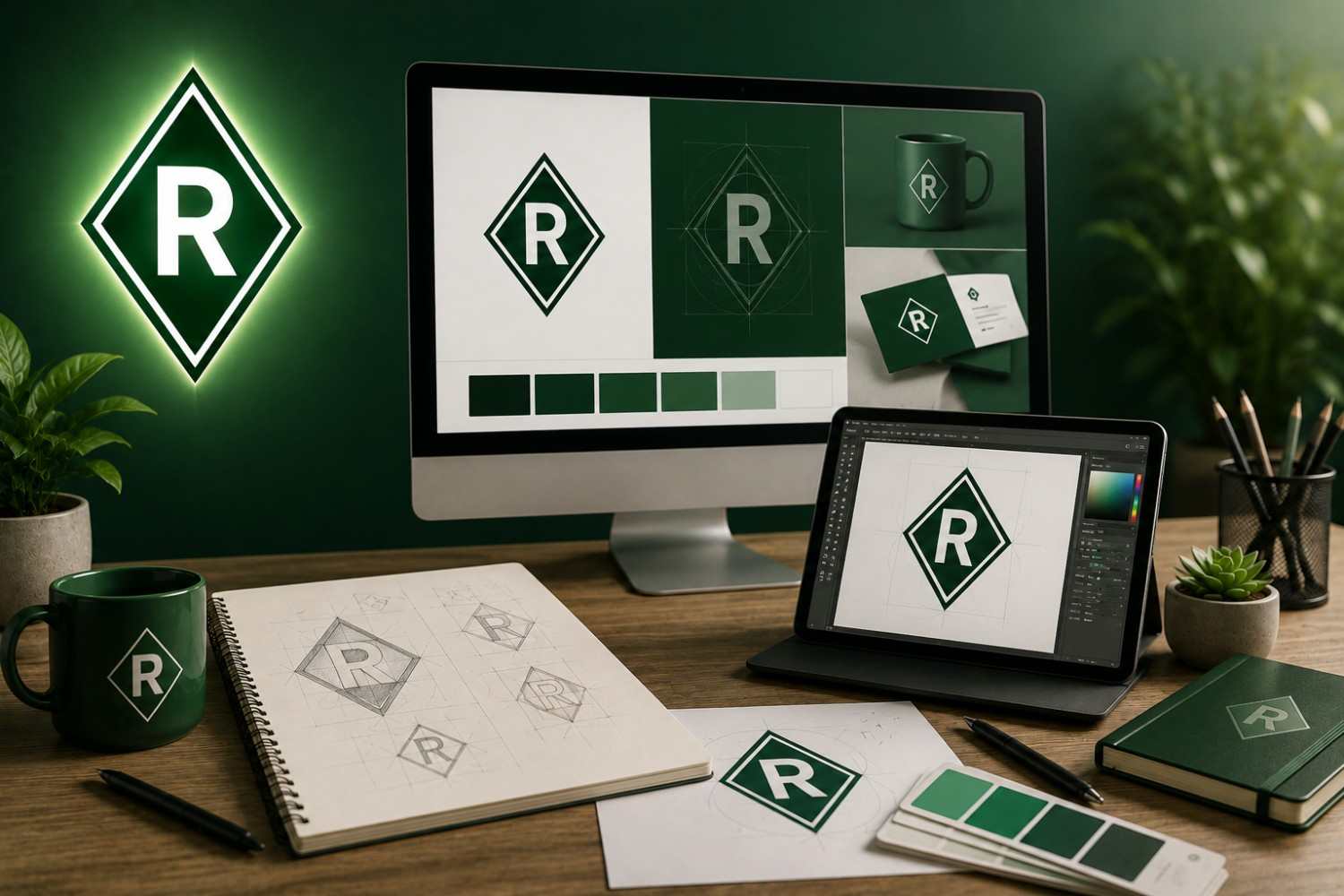
This is the stage most clients picture when they think about how a professional logo designer creates a logo in the creative development phase. This step usually takes a few days as designers need to generate quantity first, sketching many rough concepts before judging them against the brand strategy to select the most promising ideas to execute digitally.
What happens in this stage:
- The designer generates 20–50 rough sketch ideas, exploring multiple visual directions
- Strong concepts are selected from the sketches and refined
- Refined concepts are translated into digital vector form in Adobe Illustrator
- Color options, typography pairings, and spacing are tested for each digital concept
- The designer tests each concept at multiple sizes from a business card to a billboard and in both color and black-and-white
Test in one color first, then refine spacing, thickness, and contrast. Avoid too many details, weak contrast, trendy effects, and mismatched styles. A professional designer applies these standards during development which is why the concepts you receive for review are already functional across use cases, not just polished mockups that fall apart on a phone screen.
Stage 4: Concept Presentation What to Expect When Reviewing Your Logo Concepts
This is the moment most clients look forward to most, and it is also the moment where client preparation makes the biggest difference in outcome.
What you will typically receive:
- 2–3 distinct logo concepts each representing a different visual direction
- Each concept shown in color, black-and-white, and reversed (white on dark)
- Mockups showing each concept in realistic use contexts business card, website header, social profile, signage
It is a good idea to present several designs to the client to see their reaction and then select the best direction for implementing their brand.
How to give effective feedback on your logo concepts:
This is the most important client skill in the entire logo design workflow. Vague feedback like “I like it but something feels off” or “can you make it pop more” wastes revision rounds and frustrates both parties. Specific, structured feedback produces better results faster.
Instead of: “I don’t love the font.” Try: “The font feels too casual for the professional audience I serve. I want something with more authority.”
Instead of: “Can you try something different?” Try: “I like the icon direction in Concept A, but I want to explore whether it works with the color palette from Concept C.”
What professional logo design revisions typically include:
- Rounds 1–2: major direction adjustments color, icon style, typography choice
- Rounds 3–4: refinement spacing, weight, proportional adjustments
- Rounds 5+: minor polish final color values, file cleanup
Most professional logo design engagements include 2–3 rounds of revisions. If you find yourself in round five or six, the issue is almost always that the brief was not specific enough at the start, not that the designer is not talented.
Stage 5: Finalization and Logo File Delivery
Once the design is approved, the designer prepares your final logo files for delivery. This stage is more technical than it sounds, and what you receive in your final package matters enormously for how usable your logo will be across different applications.
What file formats you should expect in your final logo package:
| File Format | Best Used For | Why It Matters |
| SVG | Web, digital use | Scalable looks perfect at any size |
| EPS / AI | Print production | Industry standard for printers and sign makers |
| PNG (transparent) | Website, social media, presentations | Background-free for overlay use |
| PNG (white background) | Documents, emails | Universal compatibility |
| Professional printing | Print-ready, scalable | |
| JPEG | General digital use | Compressed for fast loading |
Color variations you should receive:
- Full color (primary version)
- Black (for dark printing, embroidery)
- White (for use on dark backgrounds)
- Grayscale (for fax, certain print applications)
Horizontal and vertical layout variations: Most logos need both a horizontal (landscape) version and a stacked (portrait) version because different applications have different shape constraints. A professional designer delivers both.
Wrap it up with guidelines document usage, clear space, color rules, and do’s and don’ts so teams and vendors stay on track. For a logo that will last, brand guidelines are the tool that protects consistency across every future application.
How Long Does the Logo Design Process Take?
One of the most common questions in any initial consultation is timeline. Here is a realistic guide:
| Project Scope | Realistic Timeline |
| Single logo design | 2–3 weeks |
| Logo + color palette + typography | 3–4 weeks |
| Full brand identity package | 5–8 weeks |
| Logo redesign (existing brand) | 2–4 weeks |
| Rush delivery (expedited) | 1–2 weeks (additional fee typically applies) |
Timeline is directly affected by how quickly clients provide feedback and approvals at each stage. A client who responds within 24–48 hours moves a project from brief to final files in three weeks. A client who takes five days per round extends the same project to five or six weeks.
Choosing a Logo Designer: DIY vs Professional A Realistic Comparison
| Factor | Logo Generator / DIY | Professional Designer |
| Cost | $0–$99 | $500–$5,000+ |
| Originality | Template-based not unique | 100% custom, original artwork |
| Brand strategy | None | Full discovery, research, competitive analysis |
| File formats | Limited (usually PNG only) | Complete file package in all formats |
| Scalability | Often not vector poor on large formats | Fully vector, scales to any size |
| Revisions | Restricted | Included rounds of structured feedback |
| Trademark eligibility | Often ineligible (template-based) | Original work is trademarkable |
| Longevity | Typically needs replacing in 2–3 years | Built to last 10+ years |
Color increases brand recognition by up to 80%, and 25% of consumers are more likely to purchase from a business whose logo they recognize. A custom logo from a professional designer is not a vanity expense, it is a revenue asset. Every year customers recognize your logo is a year of compound brand equity building.
Our Experience Working With Ohio Small Businesses on Logo Design
At Richwood Marketing, every logo we create for Ohio businesses Richwood Bank business customers in Marysville, Delaware, Marion, Bellefontaine, Plain City, Urbana, and the surrounding communities starts with a discovery conversation and ends with a complete file package that works everywhere the client needs it.
We have watched Ohio businesses go through online logo generators, spend $30, and then spend $1,500 two years later fixing branding that did not scale, did not print correctly, or did not differentiate them from competitors. We have also seen what happens when a business invests in a structured, professional process from the start: a logo that shows up consistently across their website, their Google Business Profile, their vehicle, and their signage building recognition every time a potential customer sees it.
According to AIGA’s research on design value, businesses that invest in professional design are more likely to report above-average business performance than those that do not have a consistent finding across company sizes and industries.
Explore Richwood Marketing’s services to see how logo design connects to our full-service approach including website design, content creation, and local SEO so every piece of your brand works together rather than in isolation.
Recommendation Block: What to Prepare Before Starting the Logo Design Process
| What to Prepare | Why It Matters |
| 3–5 logo examples you admire | Gives designer a visual reference point for your taste |
| 2–3 logos you dislike (and why) | Prevents the designer from going in a direction you will reject |
| Your target customer description | Ensures the logo speaks to the right audience |
| Where the logo will be used | Determines what sizes and formats the design must work in |
| Existing brand elements to keep | Prevents creative conflict with assets already in market |
| Brand adjectives (3–5 words) | Anchors every creative decision to a consistent emotional direction |
| Budget and timeline expectations | Allows scope to be set correctly from day one |
Frequently Asked Questions
What is the logo design process step by step?
The standard logo design process follows six stages: discovery consultation and brief, competitive research and brand strategy, concept sketching and development, digital refinement and concept presentation, client review and revisions, and final file delivery. Most professional engagements take 2–4 weeks from brief to final files.
How many logo concepts should I expect from a professional designer?
Most professional logo design engagements include 2–3 distinct initial concepts each representing a genuinely different visual direction. More concepts are not always better; too many options creates decision fatigue and slows the process without improving the outcome.
What file formats should I receive when my logo design is complete?
A complete professional logo package should include SVG, EPS or AI (vector), PNG with transparent background, PNG with white background, PDF, and JPEG in full color, black, white, and grayscale variations, with both horizontal and stacked layout versions.
How many revision rounds are included in a typical logo design project?
Most professional logo design engagements include 2–3 rounds of structured revisions. The number of rounds matters less than the quality of feedback at each round specific, strategic feedback produces stronger results in fewer rounds than vague or emotional reactions.
How long does the logo design process take for a small business?
A single custom logo typically takes 2–3 weeks from approved brief to final file delivery. A full brand identity package logo, color palette, typography system, and brand guidelines typically takes 5–8 weeks. Timeline is significantly affected by how quickly clients provide feedback at each stage.
Can I trademark a logo created by a professional designer?
Yes original, custom logos created by a professional designer are eligible for trademark registration, provided the design is sufficiently distinctive. Template-based logos from online generators often are not eligible for trademark protection because the same design elements are licensed to multiple businesses simultaneously.
Conclusion: The Logo Design Process Is a Partnership, Not a Transaction
The logo design process and what to expect in reality is this: a professional logo engagement is a structured creative partnership between a designer who understands visual communication and a client who understands their business, their customers, and their goals. When both sides come prepared with a clear brief, honest feedback, and patience for the process to work correctly the result is a brand asset that compounds in value every year customers recognize it.
The businesses with the strongest logos are not the ones with the biggest budgets. They are the ones who respected the process, gave specific feedback, and chose a designer who took the time to understand their brand before drawing the first line.
Claim your free marketing consultation with Richwood Marketing to talk through your logo design project whether you are starting a new Ohio business, rebranding an established one, or finally replacing the placeholder logo you have been meaning to upgrade for two years.
