

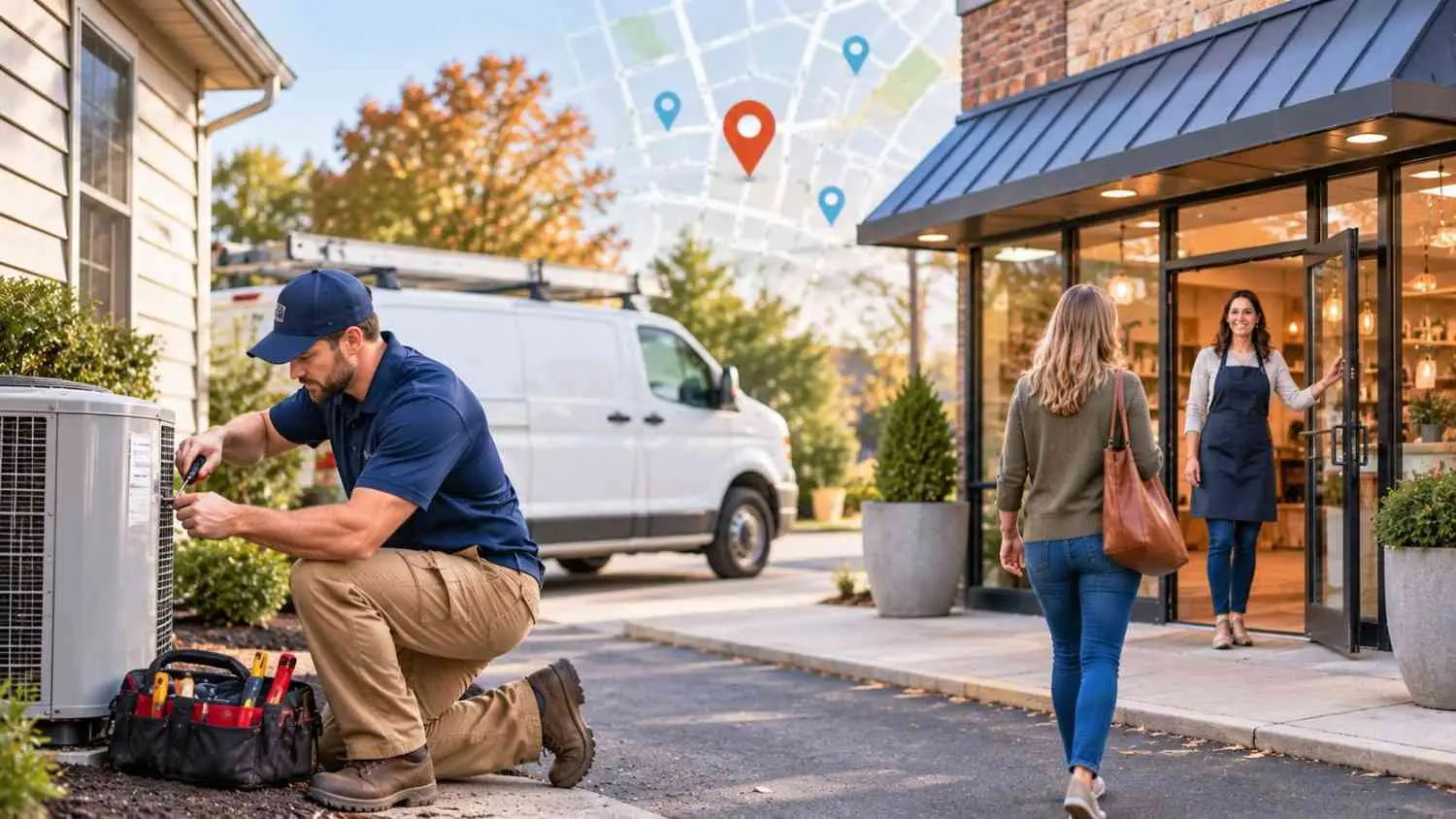
Your phone should be ringing in January. Instead, an HVAC company in Dayton watches a competitor with a weaker website collect every furnace call from the map results. The gap often comes down to one setting: the Google Business Profile was built like a shop when the business is really a truck.
That is the heart of service area business local SEO. If your crews travel to customers, set up as a service area business and hide the address. If customers walk into a staffed location, you are a storefront. Pick wrong and you lose visibility, sometimes the whole listing. Here is how each type works, how they rank, and how to choose the right approach for getting found by local customers.
What Is a Service Area Business in Local SEO?
A service area business goes to its customers. Plumbers in Columbus, HVAC crews in Cleveland, electricians in Cincinnati, roofers in Toledo, and cleaners or landscapers in Akron all fit. Customers never visit the office.
According to Google’s Business Profile guidelines, these businesses should hide the address and list the areas they serve, up to 20 cities, counties, or ZIP codes. With no map pin to lean on, service area business SEO depends on reviews, categories, and website content that proves where you work.
What Is a Storefront Business in Local SEO?
A storefront has a staffed location the public visits, such as a showroom, salon, restaurant, or flooring store. Google shows the full address and a map pin, and that pin anchors distance. This storefront local SEO model also brings directions requests, posted hours, and in-person reviews. The location must be real and open, or the listing risks suspension.
Service Area vs Storefront Local SEO: Side-by-Side Comparison
| Factor | Service Area Business | Storefront Business |
| Address visibility | Hidden; service areas shown | Address and map pin shown |
| Distance | Measured from a hidden location, less precise | Measured from the visible pin |
| Map pack behavior | Driven by reviews, relevance, city content | Same, plus a proximity edge |
| Directions requests | None | Common and useful |
| Website strategy | City and service pages | Strong location page |
| Review strategy | Name the service and city | Cover the visit |
| Citations (NAP) | Consistent name and phone, address withheld | Consistent name, address, phone |
| Typical advantage | Strong with tight content and reviews | Slight edge near the pin |
How Google Ranks Service Area Businesses Differently
Google weighs relevance, distance, and prominence for both types, but the balance shifts.
Relevance comes from your primary category, listed services, and website language. Distance favors storefronts, since a visible pin gives them a precise anchor, especially on “near me” searches. Prominence covers reviews, links, and reputation, and it is where service area businesses win.
The map pack shows only three businesses, and the ones that land there tend to share the same traits: a precise primary category, steady recent reviews, and real website pages for each market. Ohio adds its own twist. In crowded metros like Columbus and Cleveland, a suburban contractor struggles to appear for downtown searches, while smaller markets reward a strong profile with wide reach. That is why service area vs storefront SEO Ohio decisions should start with where customers actually search, and why a GMB ranking service focuses on tightening these signals rather than chasing tricks.
Decision Guide: Service Area or Storefront for Ohio Contractors
Ask four questions:
- Do customers ever walk in to buy or meet with you?
- Is someone there during your listed hours?
- Is the space open to the public?
- Do you do most work at the customer’s property?
Three no answers and a yes on the fourth make you a service area business, which covers most plumbers, electricians, HVAC companies, roofers, and cleaners. A hybrid works only when customers truly visit a staffed location and crews also travel.
One firm warning: never use a fake storefront address. Virtual offices and mailboxes break Google’s rules, and a suspension can last weeks while calls go to competitors. For most home service businesses, the right move is service area setup with the address hidden.
How to Win with Service Area Business Local SEO in Ohio
Set up the profile correctly
Choose the service area option, hide the address, and pick the most specific primary category. Add only the cities you actually reach, such as Columbus, Dublin, Westerville, and Hilliard, not half the state.
Build real city pages
Give each major market a page with local problems, project examples, and photos: freeze-damaged pipes in Toledo, older homes in Cleveland Heights. Templates with swapped city names do not help. A tailored local SEO for contractors plan usually starts here, and this multi-city ranking breakdown shows how to scale it.
Earn reviews that name the work and the city
A review mentioning a water heater repair in Lakewood tells Google what you do and where. Send a direct link right after each job and let customers use their own words.
Keep citations consistent
Use the same name and phone everywhere, leave the address off where allowed, and clean up duplicates.
Earn local mentions
Chamber of commerce listings, supplier directories, and local sponsorships build prominence that reviews alone cannot.
Link it all together
Connect service pages to city pages and back again. For more profile detail, these Google Business Profile tips cover each field worth filling in.
Common Mistakes in Service Area Business SEO
- Showing a home address publicly: It invites unwanted visits and confuses the listing.
- Oversized service areas: Listing every Ohio city dilutes relevance.
- Acting like a storefront: Visitor hours and showroom language mislead Google and customers.
- Thin “Areas We Serve” pages: One list of forty cities gives Google nothing to work with.
- Ignoring city signals: Reviews, photos, and pages that never name locations weaken your local ties.
Hybrid Local SEO: When You Have a Shop and Mobile Crews
A landscaper with a public garden center, or an HVAC firm with a parts counter, can show its address and still list service areas. Keep hours accurate, keep shop and service pages distinct, add only areas your crews truly serve, and collect both in-store and on-site reviews. If the shop is just storage, run as a service area business.
Why Trust This Advice
This comes from Richwood Marketing, an Ohio team that works on real Google Business Profiles for plumbers, HVAC companies, and roofers. The advice follows Google’s published guidelines, and the examples reflect Ohio cities, seasons, and competition.
Frequently Asked Questions
Does a service area business rank worse than a storefront?
Not necessarily. Storefronts get a small edge close to their pin, but strong reviews, accurate categories, and city-focused content let service area businesses match or beat them.
Should contractors hide their address on Google Business Profile?
Yes, if customers do not visit and crews travel to jobs. Google’s guidelines call for hiding the address, and showing an unusable one creates confusion and risk.
Can a service area business rank in the Google Map Pack?
Yes. Service area businesses appear in the map pack daily when relevance, distance, and prominence line up, especially with steady reviews and clear city content.
How many service areas can I add on Google?
Google allows up to 20 service areas. More is not better, so list only the places you genuinely serve and can reach quickly.
What is the difference between service area and storefront on GMB?
A storefront shows its address and pin because customers visit. A service area business hides the address and lists areas served because the work happens at the customer’s location.
Do I need city pages if I am a service area business?
Usually yes. City pages prove you work in each market, but they only help when each one carries real local details instead of a swapped-in city name.
Is service area business local SEO different in Ohio?
The rules are national, but strategy shifts by market. Ohio’s dense metros, smaller regional cities, and seasonal demand for heating, roofing, and lawn care shape where to focus.
Conclusion
Match your profile to how your business really runs: show the address if customers visit, hide it if you travel, and let reviews and city pages do the work.
Want to see where you rank today, which Ohio cities you are missing, and what to fix first? Book a free consultation and leave with a clear plan to win more local calls.
Local search rewards honesty and consistency. Contractors who start now will be the ones customers find first when the next furnace quits.
