

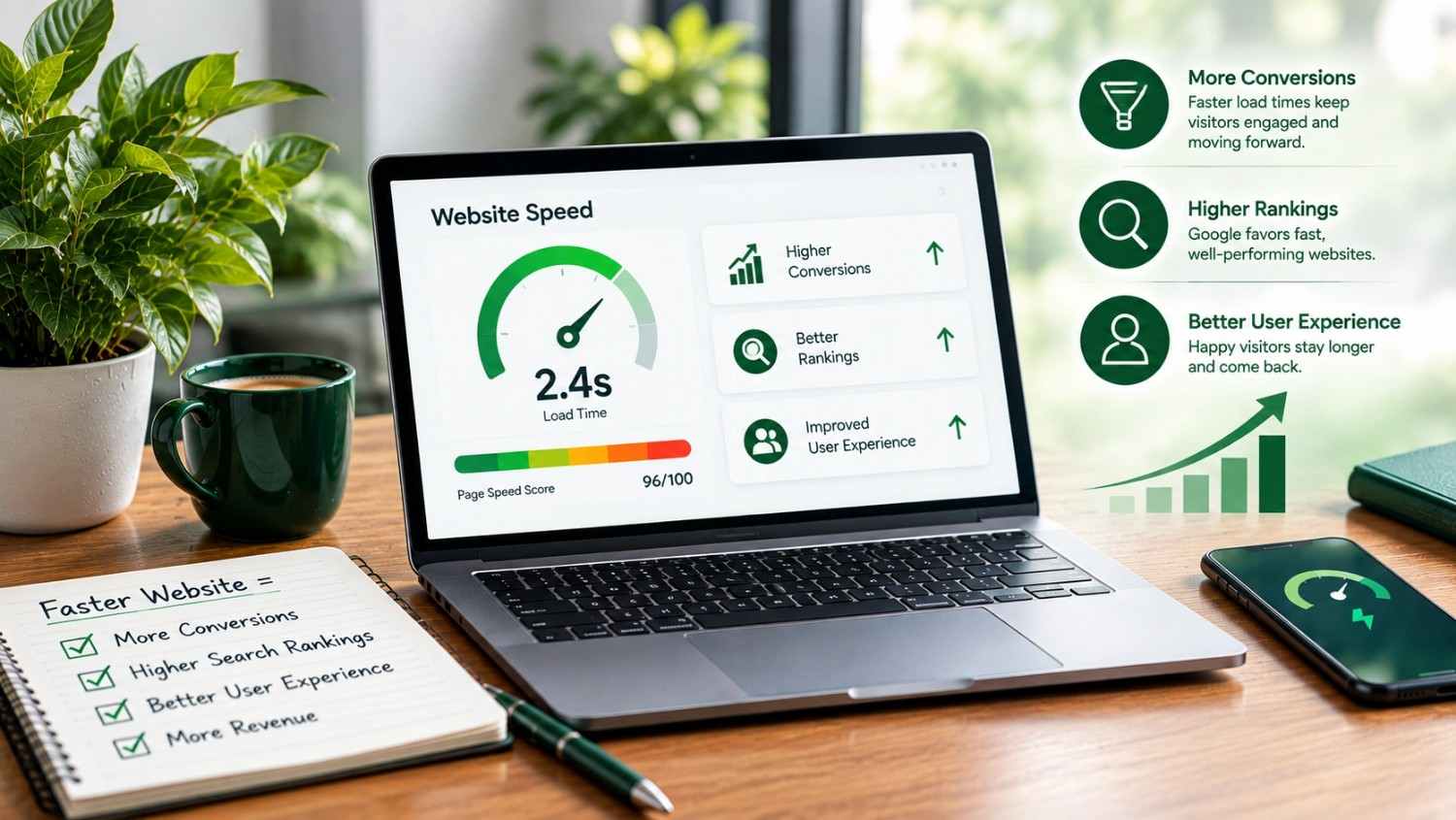
Website speed and conversions are directly linked Even small improvements in page speed can improve conversion performance. Research from Deloitte found that a 0.1-second improvement in mobile site speed was associated with measurable improvements in conversion and engagement metrics across several industries. and increase bounce rate significantly, especially on mobile. Website speed also affects Core Web Vitals are used by Google’s ranking systems as part of its broader page-experience evaluation. However, they are not a standalone ranking boost, and strong Core Web Vitals do not guarantee higher rankings. Relevance, content quality, and other ranking signals remain important. Many websites still fail to meet Google’s recommended Core Web Vitals thresholds, making performance optimization an important opportunity for businesses. The fix, in most cases, is image compression, script cleanup, better hosting, and caching, changes that typically show measurable results in rankings and conversion rate within four to six weeks.
If your website looks great but takes five, seven, or ten seconds to load, it’s not a design problem, it’s a revenue problem. Business owners searching for how website speed impacts conversions and rankings usually already suspect their site is too slow, they just haven’t seen the numbers that confirm it. Here’s the short version: page load speed affects conversion rates in a measurable, predictable way, and Google now uses your site’s real-world performance as a ranking factor. This guide walks through exactly what that means for your business, what the current 2026 data says, and what to actually do about it.
What Is Website Speed, and Why Does It Matter for Small Business Websites?
Website performance refers to how quickly your site loads, becomes interactive, and stays visually stable while a visitor uses it. Three specific metrics, known as Core Web Vitals, define this experience for Google:
- Largest Contentful Paint (LCP) how long it takes your main content (hero image, headline, or video) to load. Good: under 2.5 seconds.
- Interaction to Next Paint (INP) how quickly your page responds when someone clicks or taps. Good: under 200 milliseconds.
- Cumulative Layout Shift (CLS) how much your page visually jumps around while loading. Good: under 0.1.
Google introduced Core Web Vitals as an official ranking signal in 2021 and continues to use them today to evaluate website performance and search engine rankings together, not separately. If your page loading time fails these thresholds, you’re not just delivering a worse experience, you’re handing Google a reason to rank a faster competitor above you.
How Website Speed Impacts Conversions
This is where the business case becomes impossible to ignore. Independent performance research consistently shows that a one-second delay in load time reduces conversions by an average of 7%, decreases page views, and lowers customer satisfaction. For a business generating meaningful online revenue, that single second can translate into tens of thousands of dollars in lost sales annually.
The relationship between website loading speed and conversion rate gets worse the longer a visitor waits:
| Load Time | Typical Visitor Behavior |
| 0–2 seconds | Most visitors stay and engage normally |
| 3 seconds | Bounce probability increases sharply, especially on mobile |
| 5 seconds | B2B conversion rates can drop to roughly a third of a 1-second page |
| 10 seconds | Bounce probability increases by over 100% compared to a 1-second load |
Mobile users are even less patient. More than half of mobile visitors will abandon a site that takes longer than three seconds to load, and For many businesses, mobile accounts for a substantial share of website traffic, so mobile performance should be tested separately rather than assuming desktop performance represents the customer experience.
Recommendation: If most of your traffic comes from mobile (check Google Analytics to confirm), prioritize mobile Core Web Vitals scores first. Google uses the mobile version of a website’s content for indexing and ranking through mobile-first indexing, making mobile usability and performance important considerations for businesses.
The Relationship Between Website Speed and SEO
Beyond conversions, the impact of website speed on SEO is well documented. Google evaluates Core Web Vitals using real visitor data collected over a rolling 28-day period, not a one-time lab test, so your scores reflect how actual customers experience your site, not just how it performs under ideal conditions.
Here’s the nuance most guides skip: Core Web Vitals are not the single biggest ranking factor. Content relevance, search intent match, and backlink authority typically carry more weight. But when two pages are otherwise similar in quality, website performance and search engine rankings become the tiebreaker, and that tiebreaker matters more than it sounds. The difference between ranking in position 3 versus position 8 can double or triple the organic traffic a page receives, all else being equal. Sites that pass all three Core Web Vitals also tend to see meaningfully higher organic traffic on average than sites that don’t.
You can review Google’s own documentation on how these metrics are measured and weighted directly from Google Search Central’s Core Web Vitals guide if you want the technical detail straight from the source.
How Page Load Time Affects User Experience
How page load time affects user experience goes beyond patience, it shapes trust. A slow page reads as unprofessional even when the content and design are strong. A page that stutters when someone clicks a button or jumps around while loading creates the impression that a site is broken, even if it technically isn’t.
This is also where website usability and speed overlap directly:
- A slow-loading contact form loses submissions before they’re ever completed
- Layout shifts cause accidental clicks, especially on mobile, which frustrates visitors and increases exits
- A hero image that takes too long to appear delays the moment a visitor understands what your business actually does
Every one of these micro-frustrations adds up to fewer leads and phone calls, even when your traffic numbers stay the same.
Is Fast Website Speed Really Worth the Investment? A Comparison
Business owners often ask whether website speed optimization for better conversions is worth prioritizing over other marketing spend. Here’s an honest side-by-side look:
| Factor | Slow, Unoptimized Website | Speed-Optimized Website |
| Core Web Vitals status | Fails one or more metrics | Passes LCP, INP, and CLS |
| Mobile experience | Slow load, layout shifts, delayed interactions | Fast load, stable layout, instant response |
| Bounce rate | High, especially on mobile | Lower, visitors stay and explore |
| Conversion rate | Suppressed by friction and delay | Higher, fewer visitors drop off mid-journey |
| Google ranking position | Loses tiebreakers to faster competitors | Gains a competitive edge when content is similar |
| Ad spend efficiency | Paying for clicks that bounce before converting | Every paid click has a fair chance to convert |
| Long-term brand perception | Feels outdated or untrustworthy | Signals professionalism and credibility |
Verdict: Speed optimization is one of the few marketing investments that improves every channel at once, SEO, paid ads, email, and social, because they all send traffic to the same website. If that website is slow, a portion of every marketing dollar you spend is being lost before it has a chance to convert.
How Fast Website Speed Improves Conversions: The Real-World Evidence
Real case data backs this up consistently across industries. Businesses that shaved even a fraction of a second off their load time have reported measurable lifts in conversions, pages per session, and mobile revenue. The pattern holds across e-commerce, B2B, and local service businesses alike: how fast website speed improves conversions isn’t theoretical, it’s one of the most consistently reproducible findings in web performance research.
At Richwood Marketing, performance isn’t an afterthought bolted onto a finished website, it’s part of the build from day one. Every site we launch is built with Core Web Vitals compliance, fast hosting, and mobile-first performance in mind, and our own web design work maintains an average page load speed of under two seconds across the client sites we manage. That’s not a coincidence, it’s the direct result of treating site speed optimization as a business requirement rather than a technical nice-to-have.
Website Speed Optimization for Better Conversions: What Actually Fixes It
Most speed problems come down to a short list of recurring issues:
- Oversized, uncompressed images the single most common cause of slow load times. Compressing and correctly sizing images can shave one to two seconds off load time immediately.
- Excess JavaScript and third-party scripts every chat widget, tracking pixel, and plugin adds processing weight that slows how quickly a page responds to clicks.
- Missing image and embed dimensions without specified sizing, browsers shift content around as it loads, hurting layout stability.
- Slow server response time cheap or overloaded hosting creates a performance ceiling that no amount of front-end optimization can fully overcome.
- No caching or content delivery network (CDN) without these, every visitor downloads your full site fresh, regardless of how many times they’ve visited before.
Some of these (image compression, removing unused plugins) can be handled without deep technical skill. Others (server upgrades, script audits, CDN configuration) generally require an experienced developer or a team that builds website performance into the foundation of every site, which is exactly the approach behind our Professional website design services in Central Ohio.
How to Check Your Own Website Speed Right Now
You don’t need to guess. Two free tools give you a clear, honest picture of where your site stands:
- Google PageSpeed Insights enter your URL and get an instant breakdown of your LCP, INP, and CLS scores for both mobile and desktop.
- Google Search Console under Experience > Core Web Vitals, this shows site-wide patterns across every page Google has indexed, not just one.
Run both. A single fast page can hide a site-wide problem, and Search Console reveals patterns that a one-page test misses.
Frequently Asked Questions
How does website speed affect conversion rate?
Slower load times increase visitor drop-off at every stage of the funnel. A one-second delay can reduce conversions by roughly 7%, and the effect compounds as load time increases, meaning a five- or ten-second page loses significantly more potential customers than a two-second page.
Does website speed really affect Google rankings?
Yes. Google has confirmed Core Web Vitals as an official ranking factor since 2021. While content relevance and backlink authority typically carry more overall weight, speed becomes the tiebreaker when two pages are otherwise similar in quality, meaning it can be the difference between page one and page two of search results.
What is a good page load time for a small business website?
Most experts recommend a Largest Contentful Paint under 2.5 seconds and full interactivity within a few seconds of a visitor landing on the page. Mobile load times should be treated as the priority benchmark since mobile traffic typically makes up the majority of visits.
Why is mobile page speed more important than desktop speed?
Mobile devices generally have less processing power and often connect over slower networks than desktop computers. Google also uses mobile performance as its primary ranking signal because most searches now happen on mobile devices, and mobile visitors are less tolerant of slow load times than desktop visitors.
Can I improve my website speed without hiring a developer?
Some fixes are accessible without technical skill, compressing images, removing unused plugins, and enabling a basic caching tool. More complex fixes like server upgrades, script audits, and CDN setup generally require an experienced web team to implement correctly without breaking site functionality.
How long does it take to see results after fixing website speed issues?
Google’s ranking data reflects a rolling 28-day window of real visitor experience, so ranking improvements typically appear within four to six weeks of a fix going live. Conversion rate improvements are often visible much sooner, sometimes within days, once visitors start experiencing the faster site.
Does bounce rate really go up when a website is slow?
Slow pages can increase abandonment, reduce engagement, and create a weaker user experience, which can hurt the business even when search traffic remains unchanged.
Final Verdict: Should Your Small Business Prioritize Website Speed?
If your website is the destination for your SEO, paid ads, and social media traffic and for most small businesses, it is, then website speed and conversions deserve a place in your marketing strategy, not just your developer’s to-do list. A fast, stable site keeps more of the traffic you’re already earning or paying for, and it gives you a genuine edge in search rankings against competitors who treat performance as an afterthought.
The businesses that win here treat speed the same way they treat design and copywriting: as a core part of the customer experience, tested regularly and improved deliberately, not fixed once and forgotten.
Want to know exactly where your website stands? See what Richwood Marketing offers as a Richwood Bank business customer, from full website builds to ongoing performance monitoring, and start the conversation contact us for a free look at your site’s current speed, Core Web Vitals scores, and what’s realistically holding your conversions back.
