

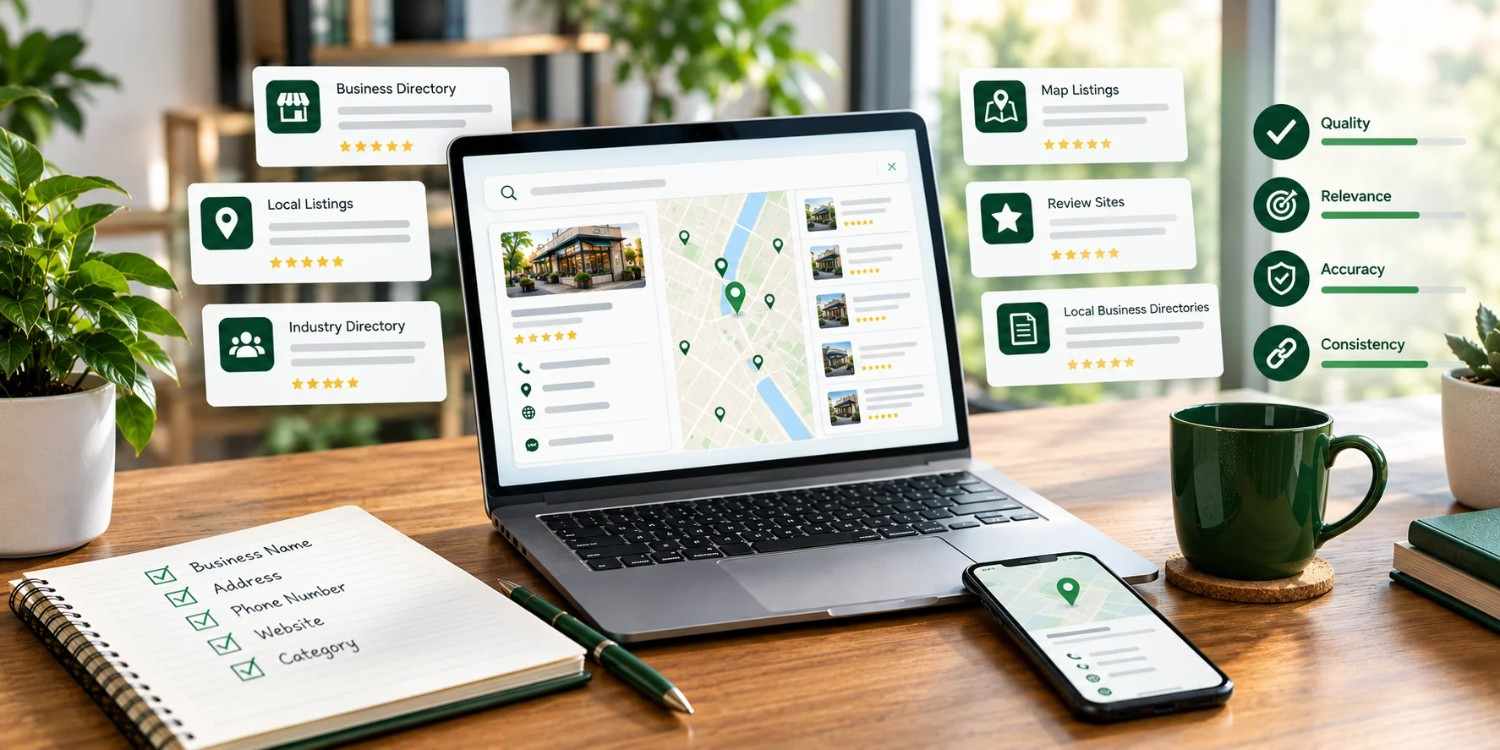
The best directory listings for local SEO are the ones Google itself cross-references to verify your business Google Business Profile, Bing Places, Apple Maps, Yelp, and Facebook followed by high-authority general directories like BBB and Angi, plus niche directories in your exact industry. Low-authority, spammy, or unmoderated directories add little value and can occasionally dilute your local search rankings instead of improving them. The goal isn’t more listings. It’s the right listings, filled out completely and kept consistent.
If you have spent an afternoon submitting your business to fifteen directories you found on a random “Top 200 Free Directories” list, you already know the frustrating part: most of them do nothing for your rankings. Some of them do not even get crawled by Google. A handful might genuinely help. The challenge small business owners face is not finding directories, it is figuring out which directories help small business SEO and which ones are simply a waste of an afternoon.
This guide breaks down the best directory listings for local SEO by real, measurable impact, not by how long a list a blog post can generate. We will show you which platforms belong at the top of your priority list, which industry-specific and citation sites for small businesses are worth the extra effort, and which “directories” you should skip entirely. We built this guide from the directory audits we run for small businesses across Central Ohio, where getting listing strategy right consistently separates businesses that show up in the local pack from businesses that do not.
What Makes a Directory Listing Actually Help Local SEO?
Before ranking any specific platform, it helps to understand what separates a directory that moves rankings from one that does not. Business directory listings for local SEO generally fall into two buckets depending on three factors:
- Domain authority and trust. Directories that Google already trusts and crawls frequently (like Yelp or BBB) pass more weight than directories with thin content and little organic traffic of their own.
- Real user traffic. A directory that actual customers browse and search is more valuable than a directory that exists purely to host backlinks. If people search Yelp or Google Maps directly, your listing there works twice as hard.
- Category and location relevance. A plumbing company listed on a plumbing-specific or Ohio-specific directory sends a stronger relevance signal than the same listing buried in a generic, unmoderated global directory.
This is essentially how directory listings help local SEO: each accurate, relevant listing acts as a small vote of confidence that tells Google your business is real, active, and located where you say it is. Google then uses that pattern of agreement to decide how confidently it can rank you in local search results and Google Maps.
Best Directory Listings for Local SEO, Ranked by Real Impact
Not every online business listing deserves equal attention. Here is how we prioritize local business directories that improve SEO based on authority, traffic, and how directly Google references them during local ranking.
| Tier | Directory Type | Examples | Why It Matters |
| Tier 1 Non-negotiable | Primary local search platforms | Google Business Profile, Bing Places, Apple Maps, Yelp, Facebook Business | Google actively cross-references these when verifying business legitimacy for the local pack |
| Tier 2 High-authority general directories | Trusted general business listing sites | BBB, Yellow Pages, Angi, Foursquare, MapQuest | Strong domain authority, real consumer traffic, and long-standing trust with search engines |
| Tier 3 Niche and local | Industry-specific and regional directories | Local Chamber of Commerce, industry associations, Ohio community directories | Sharpest relevance signal; tells Google exactly what you do and where |
Of the five Tier 1 platforms, your Google Business Profile carries the most weight, but treating it as your only listing is one of the most common mistakes we see. Google’s own guidelines for representing your business on Google make clear that consistent, accurate representation across the web supports your profile’s eligibility and trust, not just the profile itself. Research from BrightLocal’s SEO citation studies has found that businesses ranking in the top three positions for local keywords consistently carry meaningfully more directory citations than businesses sitting near position ten, with Facebook and Yelp standing out as the two most widely used listing platforms outside of Google, Apple, and Bing.
Best Business Directories for Small Business SEO by Industry
General directories only get you so far. The best citation sites for small businesses often depend heavily on what you do and who you are trying to reach.
| Industry | Best Directory Listings to Prioritize |
| Home Services (HVAC, plumbing, roofing) | Angi, Thumbtack, Houzz, Porch |
| Healthcare and Dental | Healthgrades, Zocdoc, Vitals |
| Legal and Professional Services | Avvo, FindLaw, Martindale-Hubbell |
| Restaurants and Food Service | Yelp, TripAdvisor, OpenTable |
| Retail | Google Shopping, Facebook Shops, local trade directories |
| Real Estate | Zillow, Realtor.com, Trulia |
| Financial Services | BBB, industry regulatory directories |
If your business does not fit neatly into one category, start with your local Chamber of Commerce and any statewide or regional association directory in your field. These smaller online business listings rarely bring meaningful direct traffic, but they add exactly the kind of localized relevance signal that a generic national directory cannot.
Directories That Don’t Help (And Can Occasionally Hurt)
This is the part most directory roundups skip. Not every business listing site deserves your time, and a few can genuinely work against you.
- Auto-generated scraper directories. These sites pull business data from public sources without any real moderation, human review, or user traffic. They rarely get indexed and contribute almost nothing to your local search rankings.
- Pay-to-play directories with no real visitors. If a directory’s entire pitch is “pay us and we will list you,” but it has no organic traffic of its own, you are paying for a link with little underlying trust behind it.
- Directories with wildly inconsistent NAP formatting. Some low-quality directories auto-format your business name, address, and phone number incorrectly, which introduces the exact inconsistency that can suppress your visibility. We cover this in more depth in our guide to local citations and NAP consistency, which is worth reading alongside this one since citations and directory listings work hand in hand.
- Duplicate or unclaimed old listings. If your business shows up twice on the same directory from a past submission, that duplication can confuse both users and search engines rather than reinforcing trust.
The rule of thumb: if a directory would not exist without SEO link-building as its purpose, be skeptical of it. If real customers use it to find real businesses, it is worth your time.
How Directory Submission Should Actually Work
Directory submission for local SEO works best as a sequence, not a scattershot afternoon project.
- Lock in your exact NAP format first. Decide the precise version of your business name, address, and phone number you will use everywhere, then use it without variation.
- Claim and fully complete Tier 1 listings. Google Business Profile, Bing Places, Apple Maps, Yelp, and Facebook should be 100% complete, including categories, hours, photos, and a keyword-relevant description.
- Add Tier 2 general directories. BBB, Angi, Yellow Pages, and Foursquare round out your core citation profile with strong, trusted domains.
- Layer in Tier 3 industry and local directories. These sharpen relevance and geographic signals that generic directories cannot provide.
- Skip anything you cannot verify has real traffic or moderation. If you have never heard of a directory and cannot find it referenced by a credible SEO source, it is safe to skip.
How Many Directory Listings Does a Small Business Actually Need?
There is no magic number, but most small businesses see the strongest return from 15 to 30 well-chosen, fully completed directory listings rather than 100+ low-quality ones. Quality and completeness consistently outperform sheer volume. A business with 20 accurate, active listings on relevant platforms will typically outperform a business with 150 listings scattered across directories nobody visits.
Real Patterns We See Auditing Small Business Listings
When we run listing audits for Ohio small businesses, the businesses that struggle with local visibility almost never have “too few” directories. They usually have the wrong mix: a handful of high-effort submissions to obscure directories, an incomplete Google Business Profile, and no presence at all on the two or three platforms that would have moved the needle fastest for their industry. Fixing that mix, rather than adding more listings on top of it, is usually what produces the visible ranking movement within the first 60 to 90 days.
This kind of strategic listing work is exactly what falls under Richwood Marketing’s Off-Page SEO services identifying which directories genuinely matter for your specific business and industry, building those out correctly, and maintaining them so the work does not decay over time.
Frequently Asked Questions
Do business directory listings still help SEO in 2026?
Yes. While their influence has shifted somewhat as Google weighs additional ranking factors, directory listings for local SEO remain one of the clearest ways to verify your business to search engines and to AI-driven local search tools that increasingly pull from the same directory data.
How long does it take for a new directory listing to affect rankings?
Most businesses see initial indexing within a few weeks, though the ranking impact of a fuller citation profile typically compounds over 60 to 90 days as search engines gain confidence in the consistency of your data.
Is it better to use a paid citation service or submit manually?
Both can work. Manual submission gives you full control over accuracy, while a citation service or data aggregator can push corrected information to dozens of downstream directories faster. Many small businesses benefit from a hybrid approach: manually claiming Tier 1 platforms and using aggregators for scale on lower-tier directories.
Can too many directory listings hurt my SEO?
Volume itself rarely hurts you directly, but low-quality or spammy directories can introduce inconsistent NAP data, and that inconsistency is what damages trust signals. It is not the number of listings that causes harm it is inaccurate or conflicting information across them.
What is the single most important directory for local SEO?
Google Business Profile remains the most influential individual listing, since it feeds directly into Google Maps and the local pack. That said, it works best as the anchor of a broader, consistent listing profile rather than a standalone effort.
The Bottom Line
The best directory listings for local SEO are not the longest list you can find, they are the shortest list that Google, your customers, and your industry actually trust. Prioritize the platforms search engines already cross-reference, fill them out completely, keep your information consistent, and skip anything that exists purely to sell you a backlink.
If you are not sure which directories are worth your time or how your current listings stack up, see how Richwood Marketing can help Ohio small businesses build a local search presence that actually converts into calls and customers. As a Richwood Bank business customer, you already have access to a marketing team that reviews your listings, your website, and your local competitive landscape as part of one connected strategy.
Ready to find out which directories are actually moving your rankings and which ones are dead weight? Schedule your free strategy call and we will walk through your current listing profile together.
Reference: https://support.google.com/business/answer/3038177
